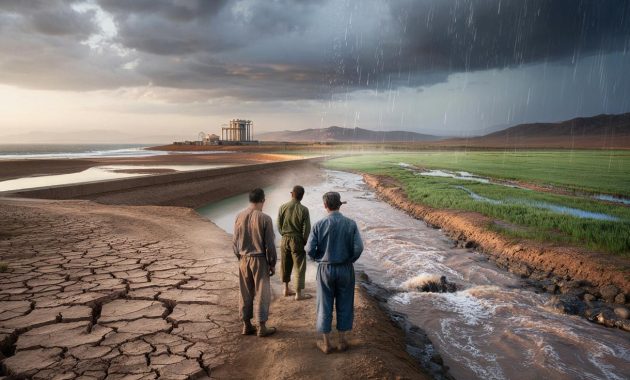
This sudden shift has stunned farmers, city planners and climate scientists alike. The skies finally opened after seven consecutive years of punishing drought, bringing hope to a thirsty nation but also raising tough questions about what kind of climate future Morocco is heading into.
From historic drought to sudden deluge
For most of the past decade, Morocco has lived under constant water stress. Fields in the Atlas foothills cracked open, reservoirs dropped to alarming levels, and rural communities saw wells dry up.
Then came the winter of 2025. Rainfall across the country surged, recording an increase of about 95% compared with the previous year. That is not a small fluctuation. It is a structural shock to a country that had started to get used to near-permanent scarcity.
After seven years of drought, Morocco has seen rainfall almost double in a single season compared with last year.
The visual change is striking. Dams that had become symbols of crisis are now reported to be at around 46% of their average capacity. Streams that had turned into dust channels are flowing again. For many Moroccans, especially in rural areas, this winter felt like a collective exhale.
A fragile relief for agriculture
The biggest immediate winner is the agricultural sector, which accounts for roughly 14% of Morocco’s GDP and supports millions of jobs.
Cereal producers in particular had been hammered by the drought, with harvests shrinking year after year and seasonal labour disappearing. This year’s rains change that picture, at least temporarily.
The spike in rainfall has halted the freefall in cereal yields and slowed job losses in the countryside, at least for this season.
With more water in dams and soils that are moist again at the surface, farmers are planting more confidently. Some irrigation schemes that had been dramatically curtailed have resumed operations. Markets are already expecting better domestic grain supply than in previous years.
➡️ Astrology: A radical life change is coming for 2 zodiac signs at the end of February.
➡️ “One in 200 million”: US fisherman hauls in electric-blue lobster in the Atlantic
➡️ “I’m a compliance assistant earning $51,400 a year with stable hours”
➡️ Psychology explains why emotional relief sometimes arrives unexpectedly
➡️ Pension increases spark outrage as many retirees lack internet access
➡️ I made this American-style meatloaf once and now it’s my go-to comfort dinner all year round
➡️ This is why standing still too long feels more tiring than walking
Yet this relief sits on shaky ground. The long-term water crisis that has gripped Morocco since the 1990s has not vanished. One wet winter does not rewrite three decades of structural hydrological stress.
Why a warmer climate brings heavier rain
Climate scientists point to a now-familiar pattern: global warming does not lead to a simple, linear drying or wetting of regions. It disrupts the entire water cycle.
As the atmosphere warms, it can hold more water vapour. When conditions align for storms, that extra moisture is released in shorter, more violent bursts.
Warmer air over the Mediterranean and North Africa means fewer, but often much more intense, rainfall events.
For Morocco, this means that classic, steady winter rains get replaced by episodes of heavy downpours. Rain that might once have fallen over several weeks can be squeezed into a few intense days. That is part of the explanation behind the 95% jump: not a gentle return to “normal”, but a spike driven by a more chaotic climate.
Hydrophobic soils: when the land refuses to drink
The problem is not just how much rain falls, but what the land does with it. After seven years of extreme heat and drought, Moroccan soils have changed.
Repeated drying and baking have made many topsoils hydrophobic: they repel water instead of absorbing it. Farmers liken it to trying to water concrete.
Much of the new rain runs off hardened ground straight into rivers and out to sea, instead of feeding aquifers.
This has three major consequences:
- Less groundwater recharge, leaving aquifers stressed even after a wet year.
- Higher flood risks when intense storms hit hardened land.
- Faster loss of surface water when the next heatwave arrives.
Experts worry that the impressive filling of dams could be short-lived. Large volumes of water are now stored in open-air reservoirs under a hotter sky, making them vulnerable to rapid evaporation during summer heatwaves.
A state betting on desalination
Faced with this volatility, Morocco has decided it cannot rely on the mood of the clouds. The government has launched a major push on seawater desalination, aiming to transform its entire water strategy by 2030.
The plan is ambitious: raise the share of desalinated water in drinking water supplies from about 25% to 60% within the next five years.
Morocco wants the Atlantic Ocean to become its main water reservoir for cities, freeing dams primarily for irrigation.
Morocco has experience here. It has been desalinating seawater since the 1970s, initially for specific coastal towns and industrial sites. What is different now is the scale: a shift from a complementary tool to a central pillar of national water security.
What the 2030 water mix could look like
| Source | Role by 2030 (planned) |
|---|---|
| Desalinated seawater | Main source for urban drinking water |
| Dams and reservoirs | Priority use for irrigation and rural supply |
| Groundwater | Backup and local use, under pressure from over-pumping |
By rerouting desalinated water to big cities, authorities hope to “sanctuarise” dam water for farms, protecting both food production and urban taps.
The heavy cost of turning seawater into tap water
Desalination does not come for free. It requires intensive infrastructure, advanced technology and huge amounts of energy.
New desalination plants will demand colossal power inputs and discharge millions of cubic metres of brine into the ocean each year.
That brine, a concentrated salty waste, can affect marine ecosystems if not handled with care. Higher salinity near discharge points may threaten seagrass, fish nurseries and local fisheries that many coastal communities depend on.
There is also the question of who pays. Large-scale desalination projects often rely on public-private partnerships, long-term contracts and complex financing, which can feed political tensions in a country where water access is highly sensitive.
Political tensions around water and power
The water question intersects sharply with politics. Prime Minister Aziz Akhannouch, himself a billionaire businessman, faces growing criticism over perceived conflicts of interest between public policy and private profit.
Opponents accuse his government of favouring large corporate holdings and export-oriented agribusiness over the needs of small farmers and low-income households. In that context, a multibillion-dirham desalination push is seen by some as both necessary and deeply suspect.
For critics, the risk is a water system where security improves on paper, but equity and transparency lag behind.
Public trust will depend on how contracts are awarded, how tariffs are set, and whether rural areas benefit as much as booming coastal cities like Casablanca, Agadir or Tangier.
Key climate and water terms worth clarifying
Two concepts sit at the heart of Morocco’s situation and are likely to crop up more often as climate change accelerates.
Intensification of the water cycle: A warmer planet speeds up evaporation and increases the moisture capacity of the air. That leads to stronger, more erratic rainfall events and, at the same time, more intense droughts between those events. Morocco’s 95% rainfall jump after years of dryness is a textbook manifestation.
Hydrological stress: This describes a long-term mismatch between water demand and natural supply, aggravated by overuse of rivers and aquifers. While a wet year can ease the pain, the structural stress remains if agriculture, cities and industry continue to consume more than the system can reliably provide.
What could the next decade look like for Morocco?
Several plausible scenarios sit on the table, and they are not mutually exclusive.
- Climate volatility intensifies: More extreme swings between drought and heavy rain make water management harder and push authorities to rely even more on engineered solutions like desalination and transfers.
- Groundwater decline continues: If pumping is not controlled, aquifers may keep falling, even in wet years, leaving rural areas exposed when surface water runs low.
- Urban–rural tensions sharpen: As cities secure desalinated water, farmers with limited access to that supply could feel left behind, widening social and regional gaps.
There are also opportunities. If desalination plants are powered increasingly by solar and wind energy—areas where Morocco is already investing heavily—the environmental footprint can shrink. Treated wastewater, still underused, could support irrigation and reduce pressure on freshwater reserves.
For households and farmers, a mixed strategy often works best: rainwater harvesting, more efficient irrigation methods like drip systems, crops tailored to arid conditions, and better insulation of urban water networks to cut leaks. Each measure seems modest alone, but together they can stretch every litre further.
The 95% jump in rainfall has bought Morocco time, not a permanent reprieve. The real test will be whether this window is used to build a water system resilient enough to withstand the next shock—whether it comes as scorching drought, another violent downpour, or both in quick succession.