
On summer evenings, when the heat finally slips off the hills and the air cools to the temperature of breath, you can stand at the edge of the field and hear it: a low, steady murmur, like the sound of distant rain that never quite arrives. It’s the bees, tens of thousands of them, stitching the twilight together with their invisible pathways. The clover trembles as they land. The wild thyme shivers. The old apple trees, gnarled and leaning, hold out their blossoms like open hands.
This is the field that was meant to be a gift. A small act of defiance against the loss of hedgerows and wildflowers, a way to give back after a lifetime of taking harvest after harvest from the soil. Instead, it has become a slow, grinding lesson in how good intentions can be caught and crushed in the gears of a tax code written for a different kind of agriculture—and a different kind of world.
The Gift of a Field
The story began the way many quiet revolutions do: with a retired man and too much time on his hands.
Peter had farmed this land for forty years. Wheat and barley mostly, some potatoes when the prices were good, a bit of grazing at the margins. When he finally put away his tractor keys for the last time, he found that the days stretched out in front of him like an empty field in winter. There are only so many times you can mend the same gate, repaint the same shed, walk the same loop down to the river and back.
What he noticed, once he stopped driving from job to job, were the absences. Fewer skylarks. Fewer butterflies. The hawthorn hedge that used to hum with life on warm days had fallen quiet.
The bees, too, were missing. He remembered them from his childhood—thick, living clouds over the beans in his father’s garden, the clumsy bumblebees nosing into the foxgloves. Now, even on the best days, the sound over his fields was mostly just wind whispering through dry stalks.
So when the local environmental collective held a talk in the village hall about pollinators—slides of declining numbers, collapsing colonies, the fragile mathematics of ecosystems—Peter listened harder than most. They talked about “rewilding corners” and “creating corridors” and, at the end, “community beekeeping initiatives.”
“What you need,” he said afterward, standing in the harsh fluorescent light with a paper cup of instant coffee in his hand, “is land.”
They laughed at first, thinking he was joking. But he wasn’t. There was a five-acre field behind his house, sloping gently towards a copse of ash and willow. It had never been his best field. Thin soil. Awkward shape. Wet at the bottom when it rained. The perfect candidate, he thought, for something other than yield figures and fertilizer schedules.
By the end of that week, an idea that had started as a casual remark had grown teeth and wings. A community apiary. Wildflower margins. Training days for schoolchildren. A place where the village could come and remember that food begins with pollen and petals, not shelves and barcodes.
The Buzz of a New Beginning
The transformation of the field felt almost like a festival. It began with spades and seed packets; it ended with laughter and aching arms and a shared, breathless sense of having done something that mattered.
The local group brought in beekeeping mentors—sunburned, soft-spoken people with propolis permanently stuck under their fingernails. They walked the field, heads bent, talking soil and sun angles, water sources and windbreaks.
“We’ll keep it simple,” one of them said. “A few hives to start with. Let the land tell us how much it wants to carry.”
Hives arrived like pale wooden suitcases stacked by the gate, the air faintly sticky with wax. Peter watched as they were carried into place on concrete blocks, spaced carefully, angled toward the sun. He felt the same mixture of anxiety and hope he used to feel when planting a new crop—only this time, instead of seeds, they were placing entire, throbbing societies of insects, tiny kingdoms with their own logic and needs.
The community showed up in gumboots and gardening gloves. Children scattered wildflower seeds as if they were broadcasting magic. Older villagers pulled out old stories, too—about keeping bees “the old way,” about hives made from wicker skeps, about leaving a bit of honey on the doorstep for luck. The field soaked in not just plants but memory.
As weeks passed, the slope changed. Bare dirt freckled with green, then flared into yellows and blues and purples. The hedgerows thickened under careful neglect. Someone built a rough-hewn bench from fallen wood. Another offered to put up a sign: “Community Bee Field – Please Walk Gently.”
Peter watched all of this unfold from a little distance, hands in his pockets, boots on the familiar soil. He had signed a simple agreement with the group: they could use the field for free, as long as it was for ecological and educational purposes. In his mind, it was not charity but balance—years of intensive cropping repaid with years of blooming and buzzing.
The first honey harvest was modest, but it felt monumental. Jars of amber, each one heavy with a sweetness that carried the taste of that particular summer: clover, bramble, wild rose. At a stall in the village fair, the jars sold out in an hour. The money went back into the project—more seed, more training, better protective suits for the volunteers.
“This,” Peter thought, looking out at the hives standing steady at the edge of the flowers, “is what my land should be doing now.”
When the Envelope Arrived
The first sign that the story was straying off its expected path didn’t come as a dying bee or a failed crop of flowers. It came in the form of a windowed envelope with his name printed too neatly on the front.
It was late autumn. Most of the flowers had long since gone to seed. The hives were quieting down for the cold months. The field had that thin, tired look land gets just before winter settles in. Peter stood at his kitchen table, kettle humming in the background, and slit open the envelope.
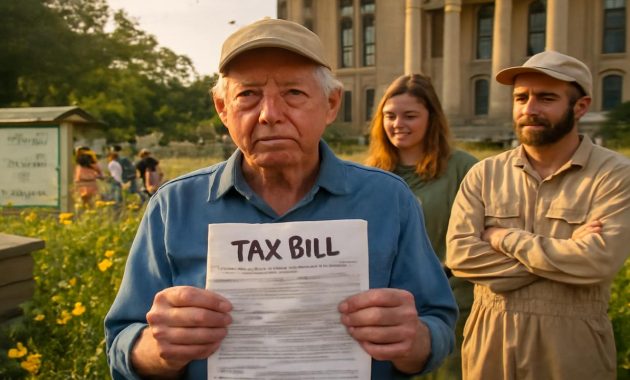
Inside was not a letter of thanks, or a polite query about continued use of the land. It was a tax notification.
He read it once, then again, a prickling starting at the back of his neck. The language was dense, full of terms that seemed to come from a parallel universe: “change of use,” “loss of agricultural relief,” “non-commercial activity,” “agricultural levy recalculation.”
The numbers were clear enough, though. The modest, predictable land tax he’d been paying for decades on that field had been recalculated. The field, no longer in qualifying agricultural production, was now subject to a different category of levy. One that assumed, in the absence of recognized commercial output, a higher valuation and a different bracket.
In short: because the field was now a home for bees and wildflowers instead of barley, the tax bill on it had ballooned into something that made his chest tighten.
He sat down slowly. The kettle clicked off, ignored. Outside, a few late wasps bumped against the windowpane, angry and lost.
The Fine Print Nobody Read
It took several visits to the tax office, a handful of phone calls spent in the voyeurism of hold music, and one very patient neighbor who was good with forms, for the full picture to emerge.
As long as Peter had been producing crops and selling them, his land qualified under agricultural-use definitions that came with certain protections and reliefs. The system, built in an age obsessed with food security and farm productivity, rewarded fields that generated recognized, taxable income from traditional farming.
But the community bee project did not fit that box. In the eyes of the law, the field was no longer straightforward farmland. The honey sales were too small and too diffuse—handled mostly by the collective, not declared as farm income. The primary purpose of the project, as stated in cheerful leaflets and meeting minutes, was ecological and educational.
That phrasing, which had made everyone proud at the time, now came back like a boomerang edged with steel.
The assessors saw a “change of use”: from conventional agriculture to what they termed “amenity” or “conservation” use. In the local rules, that meant revaluing the field for a different levy. Corners of the tax code written decades ago, when “conservation” meant wealthy estates creating shooting grounds or ornamental landscapes, now wrapped themselves around a five-acre bee sanctuary and squeezed.
The next bill was even clearer: unless he could demonstrate qualifying agricultural output or restructure the arrangement, he would be liable for an increased agricultural levy on that field. It was, effectively, a penalty for no longer treating his land as a unit of pure production.
Good Intentions, Hard Edges
When Peter explained this at the next community meeting, there was a silence that felt almost as heavy as the tax bill itself. The folding chairs creaked as people shifted uncomfortably. Nobody had imagined that giving land for bees could become a financial trap.
“Can’t they see what this is doing for the environment?” one volunteer asked, her cheeks flushed with anger. “Surely there must be exemptions.”
Someone else shook their head. “The law doesn’t care about feelings. It cares about definitions.”
They all looked at Peter. He seemed smaller under the fluorescent lights, his shoulders rounded as if the numbers on that piece of paper had physical weight.
“We could take the hives away,” he said quietly. “Let it go back to barley. That would solve it.”
But nobody could quite bring themselves to agree. To plough under the flowers and uproot the hives felt, to this little group who had fallen in love with the hum of the field, like tearing pages out of a book they’d only just started reading.
A Clash of Values
What was happening in this one field was, in miniature, a problem playing out quietly in rural corners around the country—and far beyond. Many tax and subsidy systems were designed in an age when “good land use” meant only one thing: maximizing conventional production.
Fields that grew wheat were rewarded. Fields that grew wildflowers were, at best, tolerated—and sometimes punished. Trees, ponds, hedgerows, and hives fell into a grey area the old regulations could not fully understand.
For governments facing the twin pressures of food security and limited budgets, the temptation had long been to keep rules tight: support “proper” farming, avoid loopholes. But as environmental awareness grew and climate pressures mounted, a new ethic was rising from the soil itself—one that asked land to do more than just produce calories. To store carbon, to shelter insects, to filter rain, to give people places to reconnect with the life-support systems they’d taken for granted.
In that context, Peter’s little field was not a hobby. It was part of a fragile new logic of survival. Yet the tax system still saw it as a deviation, an inefficiency to be corrected with higher levies.
Putting a Price on Pollination
On a breezy spring day, months after that first bleak meeting, Peter stood again at the top of his field, watching the bees find their rhythm among the fresh blooms. One of the beekeeping mentors joined him, veil pushed back, smoker dangling from his hand like an odd metal flower.
“You know,” the mentor said, “if you added up what these bees do for the surrounding crops—for your neighbors’ orchards, their vegetable gardens—the monetary value would be enormous.”
He was right. Ecologists have tried to put numbers on “ecosystem services” like pollination. The figures run into billions when scaled up: wild bees and managed hives together increasing yields, improving fruit quality, holding entire food webs together.
Yet on paper, in the cold columns of the tax forms, none of that counted as income. A field full of buzzing life and invisible value was seen as empty, unproductive, taxable at a higher rate precisely because it dared to step away from the old model.
Peter scuffed his boot at the soil. “Feels like they’ve found a way to tax the silence before the bees arrived… and then tax the buzzing afterward, too.”
The mentor laughed, but it was a short sound. “It’s not about you,” he said. “It’s about a system that hasn’t caught up with what the land really needs to be doing now.”
A Table of Trade-Offs
For the community group trying to help Peter, it eventually came down to hard choices. On one sheet of paper, they drew two columns, trying to lay out the options in plain terms.
| Option | Benefits | Costs & Risks |
|---|---|---|
| Return field to crops |
– Restores agricultural tax relief – Predictable financial situation for retiree |
– Loss of bee habitat and wildflowers – Ends community project and education work |
| Keep beekeeping as is |
– Maintains ecological benefits – Continues community involvement |
– Higher ongoing agricultural levy – Financial strain on a fixed retirement income |
| Restructure project as business |
– Potential to qualify as commercial use – Some reliefs may be restored |
– Administrative complexity – Pressure to prioritize profit over ecology |
| Seek grants or local support |
– Could offset tax burden – Raises public awareness of issue |
– Funding often short-term and uncertain – Time and energy needed for applications |
On paper, the choices looked almost clean. In the soil, under the clouds, they were anything but. Every option meant sacrificing something—either the retiree’s financial safety, the bees’ fragile sanctuary, or the purity of the project’s original intention.
Between Idealism and the Bottom Line
When people talk about environmentalism, they often do it in broad strokes: save the bees, protect the forests, cut emissions. They rarely mention tax forms, levy schedules, or the strange, silent battles fought in municipal offices where land use is reduced to codes and categories.
Yet this is where so many green dreams stumble—not on passion or science, but on the mundane architecture of money and law.
For retirees like Peter, the stakes are especially high. A field that once provided a modest but steady return becomes, under new rules, a source of pure cost. Pension income does not flex easily to absorb a sudden spike in levies. The generosity of offering land as a commons for bees and neighbors turns into a private liability.
Some will say: “He should have checked first.” Perhaps. But the deeper question is why a system that claims to care about landscapes and biodiversity makes it so complex—and sometimes so punishing—for ordinary people to align their choices with those values.
Imagine, instead, a tax structure that recognized pollinator habitat as a form of agricultural infrastructure. One where a field brimming with flowers and hives could qualify for as much support as one sown to monoculture. Where ecological function counted alongside market yield.
Until that happens, stories like this will continue to unfold: retirees giving up, hedgerows ploughed under to keep paperwork simple, hives moved to marginal corners where nobody asks too many questions because nobody is taking any risks for them.
What the Bees Don’t Know
On a warm afternoon in early summer, the bees fly as if the world were perfectly ordered. They do not know about agricultural levies or changing use classifications. They know only the map built into their bodies: the angle of the sun, the taste of nectar, the subtle pull of home.
They move between flowers with a steady urgency, legs dusted with gold. Each trip they make is a small act of translation, turning sunlight and petals into something that can be stored and shared—a sweetness that has nourished humans for as long as we have walked the earth.
At the edge of the field, Peter watches them land and lift off, land and lift off. Sometimes he wonders whether he should have left well enough alone, kept the field in barley, never gone to that talk in the village hall.
Then a group of children arrives with their teacher, bright caps bobbing as they walk the path between the hives. One of the volunteers kneels to show them how clover flowers are built, how a bee’s tongue fits into their tiny chambers. The children listen, eyes wide, mouths slightly open, as if the world has just been revealed to them at a new scale.
“The bees are like little farmers,” the volunteer says. “They help grow the food you eat.”
Peter sees one girl crouch low, watching a worker bee circle a dandelion, carefully avoiding disturbing it. He wonders what she will remember years from now: the hum of this field, the tremor of wings, the idea that ordinary people can choose to give land back to the more-than-human world.
“Whatever the tax office says,” he thinks, “this is worth something.”
Questions That Won’t Stay Quiet
The case of one retiree and his bee field might seem small against the roar of global environmental crises. But it carries questions that echo far beyond those five acres:
- How do we design economic systems that support, rather than punish, ecological restoration?
- Who bears the cost when we ask land to do more than one job?
- Can generosity be protected from becoming a liability, especially for those on fixed incomes?
There are no easy answers. Some regions are experimenting with new models: tax reductions for conservation easements, pollinator credits, payments for ecosystem services. Others lag behind, clinging to definitions written in a time when “nature” was something to be controlled, not partnered with.
For now, Peter and the community group have chosen a compromise. They have restructured parts of the project, formalized some honey sales, documented training sessions and outreach in meticulous detail. An accountant with a soft spot for bees has helped them thread the needle between intention and regulation, framing the field as a hybrid of agricultural and educational use that, for the moment, softens the heaviest blows of the levy.
It is not perfect. It requires forms and receipts and registers of hive outputs that sometimes feel at odds with the gentle anarchy of wildflowers. But it buys them time—time for the bees to build, for the children to visit, for the system, perhaps, to catch up.
On some evenings, when the light is just right, the field still looks like a simple gift: land returned to buzzing, blooming life. The tax code does not care about that view. But people do. And it is people, in the end, who write the rules.
Frequently Asked Questions
Why did the retiree’s field suddenly face a higher agricultural levy?
Because the field was no longer used for traditional, commercially recognized crops, it fell outside the standard agricultural-use definitions that qualify for certain tax reliefs. Once it became primarily a conservation and community beekeeping site, the authorities treated it as a “change of use,” triggering a revaluation and higher levy.
Is community beekeeping always a tax risk for landowners?
Not always. It depends heavily on local tax laws, how the project is structured, and whether some income or qualifying output can be documented. In some places, beekeeping counts as agricultural activity; in others, especially when framed as educational or charitable, it can slip into categories that lose traditional agricultural relief.
Could the problem have been avoided with better planning?
Careful legal and financial advice before changing land use can help identify risks and possible exemptions. But even with planning, many tax systems remain poorly adapted to ecological projects, leaving landowners navigating grey areas where good intentions don’t automatically align with existing rules.
What options do landowners have if they want to support environmental projects without triggering penalties?
Options may include keeping some conventional agricultural activity alongside ecological projects, formally registering conservation agreements, structuring projects as small businesses, or seeking local grants and tax incentives where available. Talking to tax professionals familiar with rural and environmental law is crucial before making changes.
Why is this case important beyond one person’s field?
It highlights a wider tension between environmental ideals and economic reality. As more people try to use their land to support biodiversity and climate resilience, outdated tax and subsidy systems can discourage or penalize them. Stories like this reveal the need to redesign policies so that ecological restoration is rewarded, not treated as a costly deviation from “proper” land use.
