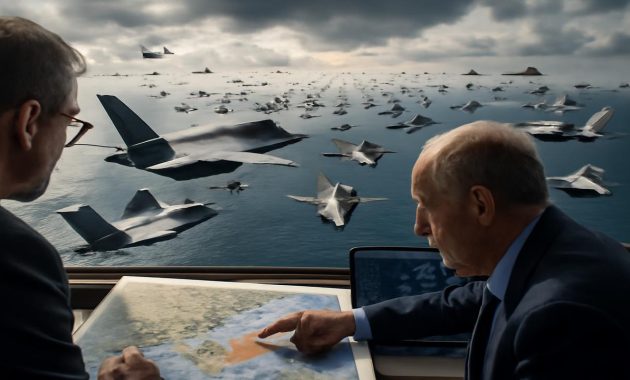

The rain had just started to fall on the flight line when the old F-16 taxied past, its gray paint worn thin by decades of sun, sand, and salt. A young crew chief in a neon vest watched it roll by, the jet’s engine shrieking against the darkening sky, and for a second the scene looked timeless—like it could have been 1995 instead of 2026. But past the concrete, beyond the wire, the world has changed. Far across the Pacific, China is building its own fleets of stealth fighters and long-range bombers, satellites and sensors, missiles that can reach out for thousands of miles. And now, a new study from an American think tank has tossed a number into the middle of that stormy sky: 500.
According to the report, that’s roughly what the U.S. Air Force and Navy together may need—500 next-generation fighters and bombers—if America hopes to prevail in a high-end war with China in the Western Pacific. It’s not just a guess, they argue; it’s the arithmetic of distance, attrition, and time. The number hangs there like a challenge: can the United States actually build that many cutting-edge aircraft, train the crews to fly them, and sustain them in a fight that could rewrite the balance of power in the 21st century?
The Pacific as a Chessboard, Not a Backdrop
The story of 500 jets isn’t really about airplanes. It’s about geography—about the feel of the Pacific itself. Imagine standing on the shore of Guam at dawn. The sea is glassy, broken only by the slow, angled shadows of tankers and gray silhouettes of warships far offshore. Between Guam, Japan, the Philippines, and Australia stretches a long, broken arc of islands and reefs—the first and second island chains, in Pentagon vocabulary, but also the ancient lanes of commerce and conflict.
China has spent the last two decades turning that space into a kind of floating fortress. Artificial islands bristle with runways and radar domes. Anti-ship and anti-air missiles sit inland, in tunnels and forests, able to reach hundreds or even thousands of miles over open water. Its air force has fielded modern stealth fighters like the J-20, and it is building new bombers meant to push beyond coastal defense into true power projection.
In that environment, the old American assumption—that a small number of highly capable planes, operating from safe, big airbases, could fly in and win the day—starts to crumble. Airfields can be cratered. Tankers can be shot down. Carriers can be targeted before their aircraft even get within striking range. The battlefield becomes a vast, contested ocean where just getting close enough to hit something is a victory in itself.
That’s where the think tank’s math begins. If China can field hundreds of advanced aircraft and missiles near its own shores, the U.S. needs enough long-range, survivable, lethal aircraft to fight through the teeth of that defenses-in-depth. Not 50. Not 100. But something more like 500—modern fighters and bombers, networked and supported, that can persist in the face of real losses.
The Old Fleet, and the Weight of History
Walk through an aging hangar at a stateside base and you can feel time pressing against aluminum. F-15s whose first pilots are now grandparents. B-52 bombers older than most of the airmen on the ramp. F-16s that have flown more sorties than anyone planned when they were designed in the 1970s. Ground crews joke that they keep some jets flying with duct tape and prayer, but there’s a sharp edge underneath the humor—the sense that the Air Force has stretched its legacy hardware almost as far as it can go.
After 9/11, the United States spent two decades flying low and slow over deserts and mountains. The wars were brutal, but the air environment was permissive. No enemy fighters prowling overhead. No long-range anti-aircraft batteries hunting tankers or AWACS or bulky cargo planes. The jets took off from safe, established bases and flew back to the same hardened shelters, day after day, year after year.
That war shaped an entire generation of pilots and commanders. Budgets flowed toward counterinsurgency support, intelligence, surveillance, and reconnaissance assets. Meanwhile, the high-end fighter and bomber fleets shrank, and future programs were cut down or delayed. The number of aircraft in the inventory fell even as their average age kept climbing.
Now, with China defined as the “pacing threat,” the Air Force is looking in the mirror and seeing an uncomfortable reflection: too many old jets, not enough stealth, insufficient range, and patchy readiness. The question the think tank is forcing into the open is whether incremental upgrades are enough—or whether the United States needs a decisive, large-scale leap into a new generation of airpower.
The 500-Jet Vision: Fighters, Bombers, and the Space Between
The number 500 is not a single aircraft line; it’s a mosaic. Picture a future fleet where sleek, angular stealth bombers share the sky with agile fighters that look almost alien compared with the fourth-generation workhorses of today. Add in uncrewed aircraft—loyal wingmen and autonomous strike platforms—that fly alongside or ahead, extending the eyes and claws of the manned jets.
At the core of this vision are two crown jewels: the Next Generation Air Dominance (NGAD) fighter and the B-21 Raider stealth bomber. NGAD is meant to replace the F-22 in the most dangerous air superiority missions: slipping into contested airspace, defeating enemy fighters, jamming or destroying radars, and opening a path for other aircraft. The B-21, meanwhile, is designed to fly long distances into the heart of advanced air defenses and deliver precision strikes, then vanish into the dark again.
But even the most advanced airframes are only as useful as their ability to survive and strike at range. The Pacific turns everything into a problem of distance: refueling, basing, maintenance, rescue. The think tank’s assessment assumes that many aircraft will face contested or denied access to traditional bases and tankers. That means the planes themselves must have longer legs, better stealth, and smarter autonomy than anything that has gone before.
When analysts talk about 500 next-gen fighters and bombers, they’re talking about a mix of types and roles, each reinforcing the other:
| Aircraft Role | Primary Mission | Key Advantage in a China Conflict |
|---|---|---|
| Next-Gen Fighters (e.g., NGAD) | Air superiority, escort, suppression of enemy air defenses | Stealth, long range, ability to control uncrewed wingmen |
| Stealth Bombers (e.g., B-21) | Deep strike against hardened, high-value targets | Penetration of dense air defenses, global reach |
| Uncrewed Combat Aircraft | Reconnaissance, strikes, electronic warfare | Lower risk to pilots, massed numbers, flexible roles |
| Support & Enablers | Refueling, command and control, ISR | Keeps the 500-effectively engaged over vast distances |
Each piece of that puzzle has to function inside a lethal zone where satellites are jammed, networks are hacked, and GPS can’t be trusted. Survivability isn’t a bonus; it’s the starting requirement.
The Human Edge: Pilots, Maintainers, and the Weight of Expectation
Numbers on a slide don’t capture the faces in the cockpit or the hands turning wrenches in the dark. Visit a squadron briefing room and you see flight suits lined up in theater-style chairs, screens glowing with threat rings and mission timelines. These are the people who would be asked to test that 500-jet theory in real life—charging into the teeth of the world’s densest air defenses with the knowledge that attrition wouldn’t just be a planning factor; it would have a name, a call sign, a family.
For pilots, next-gen aircraft promise both more capability and more complexity. A modern cockpit isn’t a panel of dials and gauges—it’s a swirl of sensor fusion: radar feeds, infrared tracks, electronic warfare displays, datalink symbols representing friendly and enemy assets across a wide battlespace. The aircraft’s computers are supposed to simplify all that, but in a war with China, the sheer pace of information and the constant threat of cyber and electronic attack would push human decision-making close to its limits.
Down on the ramp, maintainers already live with those limits. Keeping fifth-generation fighters mission-ready demands a level of technical sophistication that rivals small tech companies. In a dispersed Pacific fight, they might have to do that work from tiny, improvised strips, moving frequently to avoid missile strikes, relying on pre-positioned containers instead of sprawling, secure depots.
The think tank’s call for 500 jets is also a call for something less visible: enough trained people to fly, fix, and support them, under pressure, far from home, for as long as it takes. That human element is easy to skip in policy debates, but it may prove decisive—just as it has in every air war since the first biplanes took off over Europe.
Industry, Budgets, and the Race Against the Clock
From the outside, it can be tempting to see defense procurement as a blur of acronyms and dollar signs, detached from daily life. But imagine a factory floor in the American Midwest, the air smelling of cutting oil and warm metal, as technicians guide a composite fuselage section into a massive jig. Or an engineer in a quiet office, trading coffee for cold pizza as they run yet another simulation of electronic warfare scenarios at the edge of Chinese missile envelopes.
Those are the spaces where the 500-jet idea rises or falls. The question isn’t only whether the United States can design cutting-edge aircraft—that part of the record is strong—but whether it can design, test, and build them fast enough, in large enough numbers, to matter before the strategic balance tips too far.
Budgets are finite. Every dollar that goes toward future fighters and bombers is a dollar not spent on ships, Army long-range fires, missile defense, cyber capabilities, or domestic priorities. Lawmakers face a hard sell when they look at price tags that stretch into the tens or hundreds of billions. The think tank’s report, in effect, is arguing that the alternative—shorting the air forces of the future—is even more expensive, just in a way that won’t show up until a crisis arrives.
China, for its part, has been steadily investing in its own industrial base, turning out warships, missiles, and aircraft at a pace that has forced even seasoned analysts to recalibrate. This is not the slow, plodding Soviet design cycle of the Cold War; it’s something more iterative, adaptive, and intertwined with a vast commercial technology sector.
The race is not just about who has the shiniest jet. It’s about who can innovate, scale, and field new capabilities every few years instead of every few decades. In that rhythm, 500 aircraft aren’t a static goalpost but a moving target: a number that must be supported by software updates, production surges, and maintenance overhauls that keep them relevant against a learning, adapting adversary.
What “Winning” Might Actually Mean
Hidden beneath the talk of mass and metrics is a harder philosophical question: what does “winning” a war with China even look like? The think tank is focused on military outcomes—on being able to deny Beijing a quick, successful attack on Taiwan or other regional targets, on imposing costs high enough to deter aggression in the first place.
In that framework, 500 next-gen fighters and bombers are not instruments of conquest but of prevention. If China’s leaders look at the U.S. and allied order of battle and see a credible, resilient, lethal air and naval network capable of shutting down an invasion or smashing its logistics, they may decide that force is too risky. Deterrence, in this sense, is built not on vague threats but on concrete, visible capability.
Yet deterrence cuts both ways. Beijing watches every new U.S. program, every budget line, every speech about “prevailing” in a Pacific war. Some in China’s leadership may read the 500-jet mantra not as defensive but as encirclement—a plan to maintain American military dominance on their doorstep indefinitely. That perception can drive its own arms buildup, its own “break the siege” logic.
So the number 500 carries a double weight. It’s a bid to make war less likely by making defeat in war more likely for an aggressor. But it can also sharpen the knife’s edge of competition, adding fuel to a spiral both sides say they want to avoid. How Washington balances that contradiction—building strength while leaving room for diplomacy—will shape the way those aircraft are perceived, long before their wheels ever leave a runway.
From Numbers to Narratives: Why This Debate Matters
Step out of the policy circles for a moment and the entire debate feels abstract: 500 jets versus 300 or 700, some far-off war in the Pacific, long-range missiles arcing across seas most Americans will never cross. But look at it another way, and the story becomes deeply personal and present.
It is the teenager in rural Texas or inner-city Detroit who joins the Air Force looking for a path and discovers they may one day be sitting in the cockpit of a sixth-generation fighter, making choices in seconds that strategists debated for years. It is the software developer in Seattle whose code ends up inside mission systems, helping pilots see through electronic fog. It is the taxpayer who, without ever reading a think tank report, ends up funding a strategic bet about what kind of world their children will inherit.
The 500-jet concept crystallizes a broader inflection point: whether the United States is willing to pay the price—financial, political, industrial—to maintain a conventional edge against a peer competitor in a region central to global trade and security. The answer won’t be decided in a single defense bill. It will emerge, piece by piece, as programs get greenlit or canceled, as alliances are strengthened or allowed to drift, as citizens decide what kind of role they want their country to play beyond its shores.
Back on that rainy flight line, the old F-16 turns off the runway, its engine screaming down to a ragged whine. Soon, aircraft like it will age out, retired to desert boneyards where the hot wind scours their wings. Whether the jets that replace them are numerous and advanced enough to meet the challenge across the Pacific is still an open question. The think tank has placed its marker on the table: 500 next-generation fighters and bombers, or risk ceding the skies of the Western Pacific to a rising power.
The rest of us now have to decide what to do with that number—and what kind of future we expect it to defend.
Frequently Asked Questions
Why does a think tank say the U.S. needs 500 next-gen fighters and bombers?
The estimate comes from modeling a high-intensity conflict with China in the Western Pacific. Analysts assume heavy losses, long distances, and dense air defenses. To maintain enough combat power over time—while some aircraft are shot down, damaged, or unavailable—they conclude that roughly 500 advanced fighters and bombers would be needed across the Air Force and Navy.
What kinds of aircraft are included in that 500 number?
The figure primarily refers to next-generation stealth fighters like NGAD and long-range stealth bombers such as the B-21 Raider, along with other modern aircraft capable of surviving in heavily defended airspace. It assumes these jets will work alongside uncrewed combat aircraft and legacy platforms, but the 500 focus is on the most survivable, cutting-edge systems.
Is the U.S. Air Force close to having 500 of these aircraft now?
No. While the U.S. fields advanced jets like the F-22 and F-35 and is beginning to bring the B-21 online, the total number of truly next-generation, long-range, high-survivability platforms is well below 500. Many current aircraft are older fourth-generation types with less stealth and shorter range.
How does China’s airpower compare to the U.S.?
China has rapidly modernized its air force, fielding stealth fighters like the J-20 and building new bombers and support aircraft. It also integrates airpower with extensive missile, radar, and electronic warfare networks. While the U.S. still holds important qualitative advantages, China’s proximity to likely conflict zones and sheer volume of platforms narrow the gap.
Does building 500 next-gen jets make war more or less likely?
Supporters argue it makes war less likely by strengthening deterrence—convincing China that aggression would be too costly. Critics worry that large buildups on both sides can fuel an arms race and raise tensions. The ultimate impact depends not just on how many jets are built, but how they are paired with diplomacy, communication, and crisis management.
