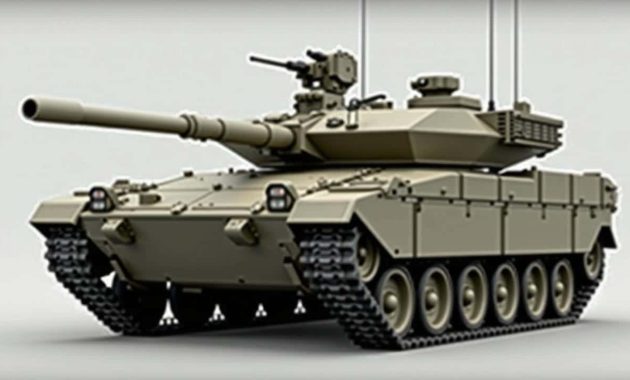
Instead of treating its remotely operated gun as an afterthought, the MAV’RX demonstrator from ARQUUS and John Cockerill Defense has been built around the turret from the very first sketch – a quiet shift that could decide which armies keep moving and which end up stranded by their own upgrades.
A new push for the “forgotten” class of armoured vehicles
Armoured fleets tend to split into two clear families: lightly protected patrol trucks on one side, and heavy 8×8 combat vehicles on the other. Between them lies a gap that many armed forces struggle to fill: a vehicle that can carry a full squad, stay protected, keep up a good pace, and still deliver credible fire support when a convoy is hit or an ambush is sprung.
The MAV’RX concept, unveiled at World Defense Show 2026 in Riyadh, aims directly at that space. It is a 19‑tonne, fully protected 4×4 that can move a section of up to ten soldiers while mounting a turret with a 20 mm or 30 mm cannon.
French industry is betting that this mid-range category will grow fast, driven by lessons from recent conflicts where troops faced drones, cheap loitering munitions, and fast, improvised ambushes far from heavy armour support.
Armies are learning the hard way that troop transports which cannot see, shoot and support their own dismounts quickly become liabilities once drones and automatic weapons appear.
From simple transport to “combat-ready” carrier
The key message from ARQUUS and John Cockerill Defense is that this 4×4 is not being pitched as a basic armoured truck. It is presented as a “combat-ready” troop carrier: able to move, absorb punishment, spot threats and return fire without waiting for a bigger vehicle to arrive.
That shift reflects a harsh reality from Ukraine to the Sahel: vehicles limited to moving personnel, with little awareness and almost no firepower, often end up abandoned or destroyed once the first serious contact happens.
Mobility first: why the desert is the benchmark
On paper, the MAV’RX is fairly conventional. It weighs 19 tonnes, measures roughly 6.98 metres long, 2.55 metres wide and 2.73 metres tall, and is powered by an 8‑litre, six‑cylinder diesel rated at around 400 hp with an automatic gearbox.
The choices look almost conservative. That is deliberate. For Gulf clients and many African or Asian buyers, the priority is not top speed in a brochure. It is the ability to drive for hours in heat and dust without cooking the engine or shredding the suspension.
➡️ A friendly cat newly arrived at the shelter steps in to help a tired mum raise her kittens (video)
➡️ The emotional reunion of two abandoned dog brothers once marked for euthanasia
➡️ Three months with the Galaxy Z Fold7: why I still can’t love foldable phones
➡️ Psychology explains that emotional numbness often develops as a short-term survival strategy
➡️ “I underestimated how fast $3 a day becomes $1,095 a year”
Independent suspension and large 14.00 R20 tyres are chosen to keep the vehicle moving on broken ground where roads are either bad or non-existent. The claimed performance figures match that intent: a 60% gradient, 30% side slope, a 0.5 m vertical step, a 1 m trench and a 1.2 m fording depth.
The point is simple: a carrier that needs a paved road in 2026 is a target, not an asset.
Protection: enough to live, light enough to deploy
The MAV’RX is not meant to be a tank. Yet it has to handle the threats soldiers most often face: rifle and machine‑gun fire, shell fragments, mines and improvised explosive devices.
The vehicle is designed around NATO’s STANAG 4569 standard for ballistic and mine protection, giving buyers a known reference point rather than vague claims. The exact level can be tuned, but the framework signals that protection is not an afterthought.
Survivability, though, goes beyond armour thickness. The demonstrator highlights:
- tropicalised air conditioning to keep crews functional in 45°C heat
- central tyre inflation and run‑flat inserts to keep moving after a puncture
- a rear camera to reduce accidents and delays in tight urban or desert compounds
Optional fits underscore where the threat is moving: CBRN protection, laser warning receivers, acoustic or optical shot‑detection, and a digital backbone capable of linking radios, GPS, intercom and battle management software.
On modern battlefields, the first warning may be a laser spot or a sensor ping, not the sound of incoming fire. Vehicles that cannot sense they are being targeted are always behind the curve.
The turret that shapes the whole vehicle
A remote weapon station as the central organ
The real gamble of the MAV’RX lies in its CLWS remotely operated weapon station from John Cockerill Defense, designed from the outset to handle a 20 mm or 30 mm automatic cannon with integrated sensors.
Many armies have learned that adding such turrets later – on vehicles never designed for them – can be a nightmare. Extra weight on the roof shifts the centre of gravity, hurting off‑road stability. Electrical systems struggle to power drives, sensors and stabilisation. Cooling needs go up. Cables and control boxes get bolted in wherever there is space, creating a fragile patchwork.
Here, the structure, power architecture and software layout are built around the turret from day one. The roof is strengthened. The weight is accounted for in suspension and chassis design. The power and data networks are sized for the turret’s sensors, day and night optics and laser rangefinder.
This matters because the turret does more than shoot. It acts as the main set of eyes and ears for the squad.
From gun to sensor hub
By combining cameras, thermal imagers and a laser rangefinder in a stabilised mount, the CLWS turns the MAV’RX into a mobile surveillance post as much as a gun truck.
In dusty, hot environments – where human vision is degraded and mirage effects are strong – a good sensor suite can be more decisive than raw speed. The turret allows the crew to scan, identify and engage threats while staying under armour, which also reduces the need for a soldier standing in a hatch with a machine gun and binoculars.
Space for ten: a small number that says a lot
The stated capacity of up to ten personnel, crew included, reveals the real ambition of the design. This is not a four‑man patrol car. It aims to move a full squad or reinforced team in one vehicle, with enough space to work, store gear and exit quickly.
That makes the MAV’RX suitable for escort duties, route security, rapid reaction missions, and static checkpoint defence, all with one common chassis.
For armed forces wrestling with stretched maintenance units and tight budgets, that commonality matters. Fewer different vehicle families can mean:
- smaller spare parts inventories
- simpler training pipelines for drivers and mechanics
- more predictable fleet availability over 20–30 years
In that sense, this 4×4 is as much a logistics proposition as a tactical one.
Riyadh as a proving ground
World Defense Show in Riyadh has quickly become a reference event for equipment designed for “hard use”: high temperatures, long distances and complex security environments. Any vehicle showcased there must, at least on paper, address those constraints.
| Date / period | Event | Capability impact |
| 8–12 February 2026 | World Defense Show 2026, Riyadh | Export shop window; benchmark against rival desert‑ready platforms |
| 8–12 February 2026 | Public presentation of MAV’RX with CLWS turret | Positions it as a combined troop carrier and fire support vehicle, not a bolt‑on upgrade |
For ARQUUS and John Cockerill Defense, the joint appearance is also a signal. Instead of a vehicle from one firm and a weapon station from another, knitted together by the buyer, they are offering a turnkey package – vehicle plus turret, with a single industrial interface for support.
Preparing for the drone-saturated battlefield
Beyond the hardware, the concept hints at how mid‑weight armoured vehicles might be used in the next decade. Commanders increasingly face “grey zone” situations: roadblocks manned by irregulars, convoys harassed by pick‑ups with heavy machine guns, quadcopters hunting for soft spots in logistics tails.
A 4×4 that can carry troops, stay off main roads, and deliver fast, accurate fire from under armour gives options. It can threaten technicals, suppress a sniper position, or cover troops as they dismount and clear a junction. With the right software and radios, it can also share what its sensors see across the wider unit.
The real change is not just bigger guns on smaller vehicles, but the fusion of mobility, sensors and protected firepower into a single, repeatable package.
Risks, trade-offs and what armies will look for
Designing around a turret from the outset does not magically fix every issue. More weight on a 4×4 limits growth potential for future armour kits. A 30 mm cannon brings powerful fire, but also recoil forces and ammunition logistics that some forces may struggle to sustain.
Armies evaluating such a vehicle will scrutinise:
- stability and rollover margins with the turret at full elevation off‑road
- electronic resilience against jamming, hacking or sensor overload
- lifecycle costs of turret maintenance and sensor upgrades
Yet the underlying lesson – that bolting on firepower late can break a good chassis – is pushing buyers towards vehicles where gun, sensors and electronics are integral, not decorative.
Key terms and scenarios
Two concepts stand out. First, STANAG 4569: a NATO standard that grades vehicles by the level of ballistic and mine protection they provide, from small‑arms resistance to survival against large roadside bombs. It allows buyers to compare offerings without relying purely on marketing language.
Second, the idea of “remote weapon station” or RWS: a weapon mount controlled from inside the vehicle via screens and joysticks. In a realistic scenario, a MAV’RX‑type vehicle under drone observation could use its RWS to engage a threat while the crew remains buttoned up, all while transmitting video and target data to other vehicles. That combination – shared awareness, protected firepower and mobility – is exactly what French industry is trying to package from the design phase, rather than patching in after the first casualties.