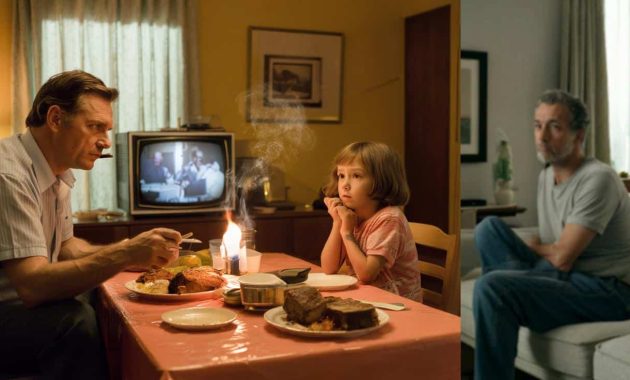
Sunday lunch, plastic tablecloth, the smell of roast meat and cigarette smoke hanging in the air. Your father barely talks, your mother clears plates in silence, the TV fills the gaps with grainy images from the news. Nobody asks how you feel. Nobody even has that word. If you grew up in the 1960s or 1970s, this scene might live somewhere in your bones, half-memory, half-muscle reflex.
Fast-forward to today, and psychologists scroll through the same childhood and use words your parents never had: trauma, hyper-independence, emotional neglect, survival strategies. What your generation once called “toughening up” is now dissected on podcasts and in therapy rooms. The strange thing? A lot of that “toughness” became real strengths. Just not in the way people thought back then.
And that’s where the story gets uncomfortable.
The seven “toughness skills” that were actually survival mechanisms
If you were raised in the 60s or 70s, you probably learned early to swallow your feelings and carry on. Crying was “for babies.” Talking about fears? A luxury no one had time for between work shifts, Cold War headlines and parents who were just trying not to drown. The language of the time was simple: you were either strong or weak. No one asked what that “strength” was costing you.
Psychology today has a different vocabulary. It calls that old-school toughness “adaptive strategies”: ways kids protect themselves when their environment can’t or won’t protect their inner world. The result? A generation with impressive mental muscles – resilience, independence, responsibility – built on foundations that sometimes quietly hurt.
Take emotional silence, for example. Many households ran on a basic script: food on the table, roof overhead, complaints forbidden. A bad day at school? “You’ll survive.” Being bullied? “Stand up for yourself.” If your parents had survived war, poverty, or strict religious upbringings, your sadness simply didn’t register on their radar.
So you learned seven “strengths” quickly: you became the kid who didn’t cry, the teenager who fixed their own problems, the young adult who got on with life no matter what. Maybe you babysat younger siblings, maybe you got a job at 15, maybe you learned to “read the room” because one wrong word could trigger an argument. From the outside, it looked like maturity. Inside, it was vigilance.
Psychologists now point out that many of those behaviors map directly onto trauma responses. Hyper-independence as a shield against disappointment. People-pleasing as a way to stay safe. Relentless productivity to avoid feeling anything at all. These aren’t weaknesses; they’re brilliant, unconscious designs from a child who had to survive emotionally on their own.
The twist is that the adult world often rewards these patterns. Employers love the worker who never says no. Families lean on the reliable one who never falls apart. Society praises the person who “just gets on with it.” That makes it even harder to notice that the strength came from a wound, not from freedom.
From “shut up and cope” to conscious strength: what changes now
One practical shift starts with language. Instead of asking, “Why am I like this?” you can ask, “Where did I learn to survive this way?” That tiny change moves you from self-blame to curiosity. If you grew up being told to be grateful and stop complaining, even naming your hurt feels rebellious.
➡️ Cognitive presence”: the psychology idea that explains why couples with a pet do better
➡️ Electric car outrage: these hidden costs make drivers furious and split public opinion
➡️ This profession offers solid income with minimal competition
➡️ If your garden attracts the same pests every year, diversity may be too low
➡️ Neither seeds nor cuttings needed: this simple trick multiplies rosemary successfully every time
A simple method is to pick one of those seven traits – maybe your extreme independence or your automatic caretaking of everyone else – and trace it back. When do you remember first doing this? Who praised you for it? Who would have been uncomfortable if you’d done the opposite? These questions don’t erase the strength. They let you own it, instead of it owning you.
The common trap for this generation is trying to “fix” themselves like another job to do. More self-help books, more routines, more pressure to heal perfectly. Let’s be honest: nobody really does this every single day. Some mornings, you just want coffee and quiet, not inner-child work.
A gentler approach is to notice the old rules still running in your head. “Don’t burden others.” “Stop being dramatic.” “Just work harder.” Whenever one of those sentences pops up, mentally add, *That was the rule in my childhood, not necessarily in my adult life.* You’re not betraying your parents by updating the script. You’re honoring the child you were, who did the best they could with the tools they had.
Psychologist Lindsay Gibson, who studies emotionally immature parents, often says that adult children of that era “grew up fast on the outside and stayed lonely on the inside.” That single line captures the strange double-life many boomers and Gen Xers still live without naming it.
- Silent endurance – Growing up, you learned not to complain. As an adult, that can become a quiet, powerful calm in crises, but it also hides your need for support.
- Hyper-responsibility – Being the “little adult” at home turned into reliability and work ethic, yet makes rest feel almost unsafe.
- Emotional numbness that looks like strength – Cutting off feelings protected you as a child. Today, it can make joy, intimacy and genuine rest strangely distant.
Each of these “skills” can evolve. They don’t have to be dismantled. Just rewritten.
What if your “trauma strengths” are actually your starting point?
There’s a quiet revolution when someone raised on “Don’t talk about it” finally admits, “That was hard.” Not to accuse, not to wallow, simply to tell the truth out loud. Many people from the 60s and 70s are arriving at that moment now, often pushed by burnout, a health scare, or watching their own children suffer in ways that look hauntingly familiar.
*The plain truth is that those seven strengths you built – self-reliance, grit, emotional control, loyalty, responsibility, adaptability, vigilance – are not the problem.* They are the evidence that you adapted, brilliantly, to a time and a culture that preferred stoicism to softness. The question is whether you still want to live by those same rules.
| Key point | Detail | Value for the reader |
|---|---|---|
| Recognizing “strengths” as survival | Traits like hyper-independence, people-pleasing and emotional numbness began as protection in childhood | Reduces shame and self-blame, opens the door to more compassionate self-understanding |
| Reframing, not deleting, toughness | Those traits can be reshaped into conscious strengths rather than automatic defenses | Lets you keep what works – resilience, calm, reliability – while easing what hurts |
| Updating inner rules | Noticing and questioning inherited beliefs like “don’t be a burden” or “feelings are weakness” | Creates space for healthier relationships, rest and emotional safety in adult life |
FAQ:
- Question 1How do I know if my “toughness” is actually a trauma response?Notice if your strength feels automatic, exhausting or panicky when you try to stop. If saying no, asking for help or showing emotion makes you feel guilty or unsafe, that “toughness” probably started as protection.
- Question 2Are we just pathologizing a normal, stricter upbringing?Not every strict or distant childhood is trauma. The point is not to label your past as “bad,” but to see honestly where emotional needs were ignored or minimized, and how that still shapes your life now.
- Question 3Can I keep my resilience without digging into painful memories?You don’t have to relive everything. Even small acts – naming patterns, allowing one trusted person to see your softer side, taking breaks without guilt – start to separate resilience from pure survival.
- Question 4What if my parents “had it worse” and I feel selfish talking about my feelings?Two things can be true. Your parents may have suffered deeply and done their best, and you may still carry unmet emotional needs. Acknowledging yours does not erase their story.
- Question 5Is it too late to change these patterns if I’m already in my 50s or 60s?Neuroscience is clear: the brain remains plastic for life. People of all ages learn to set boundaries, feel more, and soften old defenses. Change may be slower and quieter, but it is absolutely possible.