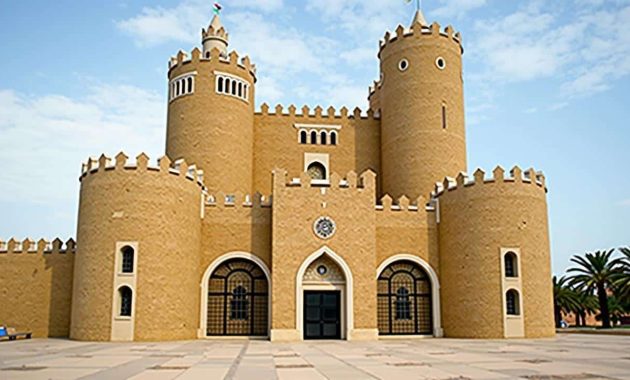
Perched on a rocky headland above the Costa Blanca, a strange red citadel rises from the cliffs, confusing almost everyone.
From a distance it could pass for an ancient desert stronghold. Up close, it turns out to be one of Spain’s boldest residential experiments, a 1970s icon that still feels quietly futuristic.
Muralla Roja: the ‘fortress’ hiding in plain sight in Calpe
The building is called Muralla Roja – the Red Wall – and it stands in Calpe, a seaside town in Alicante known for package holidays and the mighty Peñón de Ifach rock. Among the apartment blocks and hotels, this geometric labyrinth looks like it has been dropped in from another continent.
Designed in 1973 by Catalan architect Ricardo Bofill, Muralla Roja was conceived as a coastal housing complex. Yet it was deliberately given the air of a fortified casbah, playing with the idea of defence, mystique and separation from the resort sprawl around it.
Muralla Roja borrows the language of Arab citadels, but uses it to stage a very 20th‑century experiment in how people live together.
From the outside, the building forms a staggered, almost sculptural mass resting on the rocks of the La Manzanera cove. Inside, it reveals a maze of stairs, patios and narrow passages that constantly shift your sense of direction and scale.
How an Arab casbah inspired a Spanish seaside icon
Bofill and his Taller de Arquitectura drew heavily on North African casbahs, dense historic quarters where homes, passages and courtyards interlock. The aim was to rework that model for modern Mediterranean life rather than simply copy an “exotic” style.
The complex is based on a grid of intersecting Greek crosses, each arm measuring around five metres. Inside those arms sit everyday rooms such as kitchens and bathrooms. The intersections open into a system of shared courtyards that act as the lungs of the building.
There are around 50 apartments in total, ranging from compact studios of about 60 square metres to two- and three-bedroom homes reaching 80 or 120 square metres. Many units are carved deep into the structure yet still gain access to light, air and outdoor space through the network of patios and rooftop terraces.
Instead of the usual corridor-and-door layout, access in Muralla Roja flows through courtyards and exterior stairs that blur the line between ‘public’ and ‘private’ space.
➡️ I saw how they sharpen knives in India, and now I do it myself at home, even old knives become razor sharp in just one minute.
➡️ Short Haircuts: These short hairstyles that make you look 10 years younger are ideal after 50, according to an expert.
➡️ A new set of eight spacecraft images reveals the interstellar comet 3I ATLAS in astonishing clarity
➡️ Microplastics can rewire sperm, triggering diabetes in the next generation
➡️ A 7.1-magnitude earthquake strikes offshore, less than 100 km from the coast
➡️ Brazil’s Supreme Court Convicts Four Men in Murder of Marielle Franco historic verdict justice thunderous outrage social upheaval
➡️ Ancient humans left a bigger ecological footprint than scientists thought
➡️ Hairstyles after 50: Inverted coloring, the trick to enhancing gray and white hair without “root effect”
On the top levels, residents share solariums, a swimming pool and even a small sauna, all oriented towards the sea. Those communal areas were radical in the early 1970s, proposing a more social way of living at a time when Spain’s coastal boom was churning out anonymous towers.
Colours that bend the Mediterranean light
If the shape of Muralla Roja recalls a fortress, the colours pull it straight into the realm of art. Bofill’s team used paint almost as an architectural material in its own right.
The exterior walls are rendered in a range of earthy reds and pinks, from deep crimson to a softer terracotta. Seen against the pale limestone rocks of La Manzanera and the bright sea beyond, the building reads like a cut-out collage of solid colour.
Inside the courtyards and stairwells, the palette changes completely. Here, planes of blue, indigo and violet overlap, catching the sun at different times of day and altering the perceived depth of each space.
- Red and pink tones mark the outer “defensive” envelope.
- Blues and violets animate the inner, shared spaces.
- Strong shadows from the stepped geometry create constantly shifting patterns.
This chromatic strategy does more than look good on Instagram. The cooler tones help these semi-enclosed spaces feel fresher in summer, while the intense contrasts help residents orient themselves in the otherwise disorienting maze.
Postmodern before postmodern was fashionable
Muralla Roja is often described as a key moment in Spanish postmodern architecture. The label fits: the project plays with historical references, embraces bright colours and refuses the strict minimalism that dominated modernism.
At the same time, Bofill drew on constructivist ideas, stacking simple geometric volumes into complex compositions. Each stair, wall and opening has a clear role in a bigger three-dimensional puzzle.
Geometry is not just decoration here; it’s the engine that organises light, movement and privacy for 50 different homes.
Everyday practicalities were carefully considered. Kitchens and bathrooms are grouped for efficient plumbing. Thick walls help regulate temperature. Windows are placed to catch sea breezes while controlling glare.
Instead of treating architecture as a background for life, Muralla Roja treats the experience of moving through space as part of the attraction of living there.
The building that went from local curiosity to global cult
When it was completed, the complex stood apart from most Spanish coastal developments. For decades, it was better known among architects than tourists. That balance has shifted dramatically in recent years.
Social media has turned Muralla Roja into a visual phenomenon. The building’s hard lines, flat colours and improbable staircases have featured in fashion editorials, music videos and international advertising campaigns.
Calpe’s tourism office now regularly fields questions about “the red fortress” from visitors who have seen it in photos but know nothing of its history or architect. Many are surprised to learn that it is still, first and foremost, a private residential building.
| Fact | Detail |
|---|---|
| Location | La Manzanera, Calpe (Alicante), Spain |
| Architect | Ricardo Bofill Taller de Arquitectura |
| Year of design | Early 1970s, completed around 1973 |
| Number of units | Approximately 50 apartments |
| Main influences | Arab casbahs, constructivism, Mediterranean vernacular |
What it’s like to stay inside the ‘red wall’
Some owners rent their flats out short-term, which has turned Muralla Roja into a sought‑after holiday address. Staying there is not like booking a standard Costa Blanca apartment block.
Visitors talk about needing a day or two to “learn” the building. Stairs appear to lead nowhere, then open suddenly onto wide terraces. A simple walk to the pool might take you past three or four courtyards, each with a different colour and view.
These quirks are part of the charm but also raise practical questions. The abundance of steps makes accessibility limited. Signage is kept minimal to preserve the sculptural look, which can confuse newcomers. For permanent residents, that can be tiring as well as atmospheric.
Tourism pressure and everyday life
As Muralla Roja’s fame grows, there is a tension between its Instagram persona and the reality of it being people’s homes. Long photo sessions in stairwells, drones buzzing overhead and uninvited visitors wandering through private areas are recurring complaints.
For anyone keen to see the building respectfully, a few simple habits help:
- Stick to agreed visiting hours or pre-arranged tours, where available.
- Treat staircases and patios as residential corridors, not public plazas.
- Keep noise low and avoid photographing residents without consent.
These small gestures can reduce friction between architectural curiosity and day‑to‑day life, a balance that many iconic residential buildings worldwide struggle to manage.
Why Muralla Roja still matters for architecture students and city planners
Beyond its photogenic status, Muralla Roja is often dissected in architecture schools. It shows how mid-20th‑century designers tried to escape repetitive, anonymous housing without sacrificing density or efficiency.
For planners in coastal regions, the project raises pointed questions: can holiday developments offer more identity than a row of towers? Can shared spaces be designed to encourage genuine interaction rather than just providing a token pool?
Muralla Roja suggests some answers through its layered circulation, shared terraces and visual drama. At the same time, it highlights trade‑offs: complexity can mean higher maintenance, accessibility challenges and a steeper learning curve for residents.
From ‘fortress’ to living laboratory of Mediterranean life
Architects often talk about “vernacular” design – essentially, building in a way that responds to local climate, habits and materials. Muralla Roja takes that idea and amplifies it through metaphor and geometry. Thick walls, shaded patios and rooftop terraces all nod to traditional Mediterranean strategies for staying cool and social.
Anyone curious about architecture can use the building as a kind of open-air glossary. Terms such as “patio”, “solarium” or “section” stop being abstract. You feel what a patio does when a breeze passes through it on a hot afternoon, or how a section works when one staircase suddenly reveals three different levels stacked above you.
For British or American travellers bored of standard sun-and-sand breaks, a visit to Calpe with a walk around La Manzanera offers a different kind of coastal story: one where a 1970s “Arab fortress” quietly shows how radical ideas about community, colour and comfort can be built into concrete and still feel relevant half a century on.