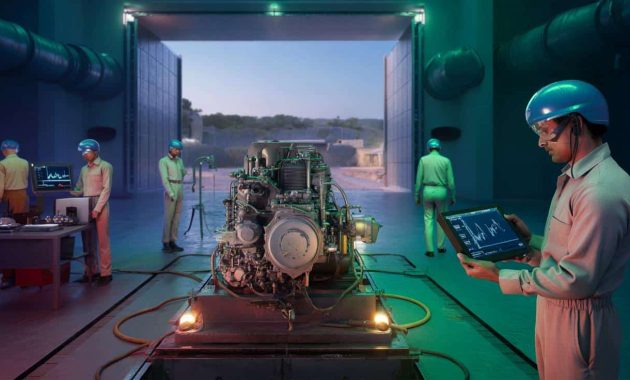
In a test facility in Hyderabad, a compact diesel engine just signalled that New Delhi is serious about breaking free from foreign suppliers for the most sensitive part of a tank: its heart.
India’s first fully homegrown tank engine takes shape
India has announced successful trials of the “Gen‑1”, a 675‑horsepower diesel engine designed and developed entirely on Indian soil for armoured vehicles. The project is led by DRDO, the Defence Research and Development Organisation, working with a cluster of domestic manufacturers.
For decades, India’s armoured forces have relied heavily on Russian designs and imported engines. The T‑72 and T‑90 fleets still dominate its heavy armour, while the indigenous Arjun tank uses a mix of local and foreign technologies. Engine technology has been a persistent weak spot.
The Gen‑1 is the first tank-grade engine India has taken from clean-sheet design to endurance testing without foreign design licensing.
The prototype delivers 675 horsepower at 3,200 rpm and has already completed 250 hours of endurance testing. Trials included variable loads, thermal stress, and simulated battlefield conditions meant to replicate everything from long marches to high-intensity manoeuvres.
This is not yet a rival to the 1,500‑horsepower powerpacks of Western main battle tanks like the US M1 Abrams or the German Leopard 2. But as a first step in a national armour engine line, it matters far beyond the raw numbers.
Why France is now behind on sovereign tank engines
The Indian push stands out because several traditional European powers, including France, have let their own heavy armoured engine industries shrink or depend on foreign suppliers.
Paris still designs and integrates armoured vehicles at a high level but relies on external partners for heavy powertrains. The Leclerc tank’s V8X‑1500 Hyperbar engine, for instance, is produced by a company linked to Finnish group Wärtsilä. France can adapt and integrate, but the entire chain from metallurgy to core engine design no longer sits within its borders.
India, which long accepted such dependence as the price of modernisation, is now moving in the opposite direction. For New Delhi, control over engines is not a matter of prestige; it is about wartime resilience.
➡️ How to make your heating warm up fast: Engineer shares a simple trick
➡️ When the door opens and her new little brother appears, this dog completely loses it (video)
➡️ It’s the worst washing-machine program and even repair techs warn against it: a real waste of water
➡️ How a drop of washing?up liquid in the toilet can have a surprisingly big effect
Building engines at home gives India flexibility under sanctions, export restrictions or sudden supply chain shocks in a crisis with China or Pakistan.
A modular “heart” for multiple armoured platforms
One core engine, many potential vehicles
DRDO has not developed the Gen‑1 with a single tank in mind. Engineers describe it as a modular “core” that can be adapted to several current and future programmes.
Indian defence planners have a long shopping list of armoured systems in various stages of development. The Gen‑1, or its successors, is intended to power a broad family of vehicles, from medium tanks to unmanned systems.
Programmes likely to be targeted include:
- Future Ready Combat Vehicle (FRCV) – a next-generation tank intended to replace aging T‑72s.
- Light tank for high-altitude warfare – under 30 tonnes, optimised for Himalayan terrain against China.
- New infantry fighting vehicle – a successor to the Abhay concept, requiring a compact yet responsive power unit.
- Unmanned ground combat systems – where Gen‑1 could act as the thermal part of a hybrid diesel-electric drive.
Designing around a core module lets industry reuse components, streamline logistics and cut development time for each new vehicle. For the army, it reduces the chaos of maintaining multiple engine families with different spare parts and training needs.
Built for harsh climates and rough maintenance
Indian engineers have also tried to align the Gen‑1 with ground realities. Many Indian Army vehicles operate far from major depots, cared for by mechanics with limited tools in difficult environments.
The engine includes local electronic controls that allow settings to be tuned to mission profiles. Cooling systems have been created for extremes ranging from the scorching Thar desert to the cold and thin air of Ladakh at altitude.
The guiding idea: a crew should be able to keep the engine running with basic tools and straightforward procedures, not a factory-level workshop.
Gen‑2, already under development, aims to push power higher in roughly the same volume while cutting thermal signature, a key factor against drones and infrared-guided weapons. Designers also want to simplify maintenance further, with more modular components that can be swapped in the field.
A club of a few global tank engine makers
The Indian initiative comes in a sector dominated by a small circle of powerful industrial players. Heavy armoured engines sit at the intersection of advanced metallurgy, precision manufacturing and military secrecy. Only a few companies can reliably produce them at scale.
Some of the main names include Germany’s MTU Friedrichshafen (now part of Rolls-Royce Power Systems), the US giants Honeywell and Cummins, South Korea’s Doosan, and several post-Soviet and Chinese manufacturers. Israel, despite advanced tank design, still leans heavily on foreign engines for its Merkava series.
The following table gives a snapshot of some leading armoured engine makers and signature products:
| Manufacturer | Country | Notable model | Power output | Associated vehicle |
|---|---|---|---|---|
| MTU Friedrichshafen | Germany | MB 873 Ka‑501 | 1,500 hp | Leopard 2 |
| Honeywell | United States | AGT1500 (turbine) | 1,500 hp | M1 Abrams |
| Cummins | United States | VTA‑903T | 600–900 hp | Bradley, M113, support vehicles |
| Doosan Infracore | South Korea | DV27K | 1,500 hp | K2 Black Panther |
| KMDB | Ukraine | 6TD‑2 | 1,200 hp | T‑84, Oplot |
| Chelyabinsk Tractor Plant | Russia | V‑92S2 | 1,000 hp | T‑90 |
| NORINCO | China | 150HB | 1,200 hp | Type 99, VT‑4 |
| Wärtsilä / Turbomeca | France / Finland | V8X‑1500 Hyperbar | 1,500 hp | Leclerc |
By nurturing a domestic competitor in this small but strategic club, India is seeking room for manoeuvre in export markets too. A tank powered by a fully Indian engine can be sold with fewer political strings attached, especially to countries wary of Western conditions or Russian reliability.
Strategic context: from drones to high-altitude standoffs
India’s engine push does not sit in isolation. It fits into a broader effort to harden supply chains and modernise its forces under pressure from a rising China and a volatile Pakistan.
New Delhi has been investing in homegrown sensors, artillery, missiles and even directed-energy weapons, such as a laser anti-drone system often cited in defence circles. Engines may sound less glamorous, but without them every other upgrade stays stuck in the design office.
An army can stockpile shells and spare tracks, but if it cannot repair or replace engines under fire, its tanks turn into bunkers.
The high-altitude stand-offs with China in Ladakh have also exposed how demanding the terrain is on imported engines. Thin air, dust, temperature swings and difficult logistics all punish powertrains. A locally developed engine can be customised around those specific stresses rather than generic European plains or North American deserts.
Key terms and real-world scenarios
What “sovereign engine industry” actually means
The term sounds abstract, but in practical terms a sovereign engine line means:
- Local design of the engine block, fuel system, and control software.
- Domestic casting and machining of critical parts like crankshafts and cylinder heads.
- National testing centres capable of full life-cycle trials.
- A domestic supply web for spare parts and overhaul services.
If any of those pieces sits abroad, a foreign government or a private supplier gains leverage. Sanctions, export permit delays, or simple commercial disputes can leave frontline units short of working vehicles.
How this could play out in a conflict
Imagine a future border crisis where India faces a long deployment along the Himalayan frontier while global supply chains are disrupted. An imported engine might require approval from the original manufacturer to ship key components or specialist teams for overhauls. If that support is slowed for political reasons, the availability of tanks could start to drop just as tensions increase.
With a national engine industry, the risk shifts. The bottleneck is no longer foreign approval but domestic industrial capacity. That brings its own challenges — funding, skilled labour, quality control — yet the decisions sit within India’s political space, not someone else’s cabinet meeting in Europe or Washington.
The Gen‑1 will not win battles on its own. It is a starting point, not an end state. But the fact that India is building an armoured engine sector that countries like France largely let wither says a lot about how seriously New Delhi takes long-term military autonomy — and how the balance of industrial power in defence is gradually tilting eastward.