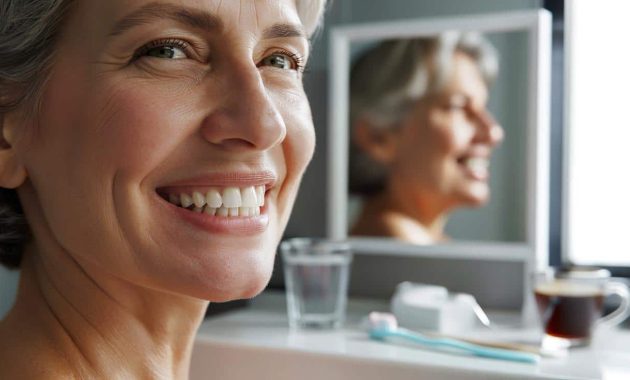
On the screen, your smile looks… fine.
Then you catch yourself in a shop window at noon, brutal daylight, and the truth jumps out: those teeth used to be whiter. You zoom in on old photos and there it is, cruel but clear. The same person, the same grin, but a few shades lighter than today.
You start replaying all the coffees, red wines, rushed brushes before bed. The years of “I’ll book that dentist appointment next month”. You wonder if it’s too late, if yellowish teeth are just part of the deal of getting older, like reading glasses and creaky knees.
They’re not. And that’s where things get interesting.
Why teeth yellow with age (even when you brush)
The first shock is realizing that yellowing isn’t always about “being dirty”. You can be a careful brusher and still watch your smile lose its sparkle after 40. The outer enamel layer thins over time, a slow, silent erosion from years of chewing, acid attacks from food, and sometimes over-enthusiastic brushing.
Under that enamel lives dentin, naturally more yellow. As enamel gets thinner, dentin shows through like an old wall under fading paint. Add stains from coffee, tea, curry, tobacco, and dark sodas, and your teeth start to carry the full story of your habits.
Age doesn’t just change color, it changes texture too. Tiny cracks appear in enamel, microscopic doorways where pigments slip in and stay. So no, you’re not imagining it: toothpaste alone feels less and less effective with time.
There’s also that strange illusion effect. Skin tone changes with age, lips lose volume, and suddenly teeth look darker even if the shade hasn’t moved that much. Dentists see this all the time. A 25-year-old with slightly yellow teeth won’t “read” the same as a 55-year-old with the exact same shade.
One London dentist told me about a patient, 62, who came in convinced her teeth had “suddenly” turned dark in six months. Old records showed only a one-shade change in eight years. What had changed fast was her skin and the way light hit her face after weight loss.
It sounds unfair, but it’s also strangely comforting: not everything you see in the mirror is as dramatic as it looks in your head. Color, contrast, context – they all team up to tell a bigger story than the simple shade of your enamel.
Another thing that surprises people is the role of dryness. As we age, saliva flow often drops because of medication, dehydration, or just time. Less saliva means less natural rinsing, more plaque film, more chance for pigments to settle. That sticky morning-mouth feeling? It’s not just unpleasant, it’s a perfect canvas for stains.
➡️ After four years of research scientists conclude remote work boosts happiness but also quietly widens inequality between employees
➡️ What exactly is “princess hair,” this hair trend that’s catching on with royalty, Kate Middleton chief among them?
➡️ It sounds brutal, but biology backs it: the island where female turtles ‘kill themselves’ to escape male harassment
➡️ Goodbye sneakers, hello to the much more feminine shoes that chic women will be wearing this spring
➡️ Germany keeps up pressure on France over joint SCAF fighter by weighing 35 more F‑35s
➡️ “It’ll be hard for humans to recover”: a top AI expert fears the job market will be destroyed
➡️ Archaeologists Are Astonished: A Mosaic Emerges Linking The History Of Rome And Ancient Egypt
➡️ The United Kingdom unveils the most gigantic project in its history: building one submarine every 18 months
Teeth also get more porous with microscopic wear. Think of a white shirt that’s been washed 300 times: the fabric thins, fibers lift, stains cling faster. That’s your enamel after decades of coffee breaks, citrus fruits, and the occasional forgotten night of brushing.
The logical takeaway is a bit harsh: the same habits that didn’t “show” at 25 start leaving fingerprints at 45. Age doesn’t forgive; it underlines.
What really works to whiten age-yellowed teeth
First, the method that actually changes color: peroxide-based whitening, supervised by a dentist. These gels (carbamide or hydrogen peroxide) go inside the enamel and break up the pigment molecules trapped there. It’s chemistry, not magic. Done well, it can lighten teeth several shades, even when yellowing is linked to age.
There are two main routes. In-office whitening, where you sit with a stronger gel under a lamp for 45–90 minutes, and at-home trays custom-made from molds of your teeth. The second method is slower – usually two weeks of wearing trays a few hours a day or overnight – but often gives a more natural, longer-lasting result.
For age-yellowed teeth, dentists often prefer a mix: one in-office session to “kickstart” and then trays to fine-tune. It’s not cheap, but if your enamel is still healthy and not too thin, this is the only technique that truly lifts the internal color, not just surface stains.
The temptation, of course, is to skip straight to whitening strips and viral TikTok hacks. And many do. Let’s be honest: nobody really reads the tiny instructions and dosage notes every single day. Strips and over-the-counter gels can work, especially on mild staining, but age changes the game a bit.
When enamel is thinner or gums are slightly receded, strong store-bought formulas sting more. People push through the discomfort, thinking “no pain, no gain”, then end up with sensitive teeth that scream at cold water and hot tea. The worst part is when they double the time “for faster results”.
There’s also the natural DIY side: rubbing with baking soda, lemon, or charcoal powders. Yes, some of these can remove surface stains, but the cost is enamel erosion and micro-scratches that, ironically, catch more stains. You win a tiny instant brightness and lose long-term protection. *That’s a bad trade, especially after 40.*
A dentist I spoke to said something that stuck with me:
“Most people don’t need more power, they need more precision. They use the strongest stuff on the whole mouth when only some teeth can handle it.”
For age-yellowed teeth, the winning combo is usually gentler, consistent habits around a targeted treatment. Think in layers:
- Professional cleaning, to strip off plaque and reveal the real starting shade
- Custom whitening plan, adapted to your enamel and sensitivity
- Daily care that respects aging teeth: soft brush, low-abrasion toothpaste
- Stain control habits: rinsing after coffee, using a straw for dark drinks
- Regular checkups to adjust, rather than “starting from zero” every few years
One plain-truth sentence here: whitening that lasts is less about one big miracle session and more about not undoing it in three months with old habits.
Rethinking “white” and making peace with your real shade
There’s a quiet shift that happens when you stop chasing the blinding Hollywood white and start aiming for “healthy, fresh, and mine”. Many people over 40 say that after treatment they don’t actually want the lightest shade on the chart. They want harmony with their skin, their eyes, their age.
That doesn’t mean giving up. It means reframing. A natural off-white smile with a uniform tone often looks younger than an artificially white one that clashes with your face. Some dentists talk their patients out of extreme whitening, or suggest restoring just the front teeth, or combining whitening with tiny bonding repairs on worn edges.
Yellowing with age is partly biology, partly lifestyle, partly lighting. Playing with all three changes how your smile looks and how you feel about it. A slightly whiter tooth, lips hydrated instead of cracked, a softer light for video calls – you don’t erase time, you tune it.
| Key point | Detail | Value for the reader |
|---|---|---|
| Understand age-related yellowing | Enamel thins, dentin shows, stains settle more easily | Removes guilt and clarifies what you can actually change |
| Choose targeted whitening | Professional peroxide-based treatments adapted to your enamel | Maximizes results while protecting sensitive, aging teeth |
| Protect results long term | Softer daily care, stain-control habits, regular checkups | Extends whitening effects and avoids the damage/repair cycle |
FAQ:
- Question 1Can you really whiten teeth that have yellowed with age?Yes, as long as the enamel is still present and reasonably healthy. Professional whitening can lighten several shades, even on older teeth, but the result is usually a natural white, not a blinding one.
- Question 2Are whitening toothpastes enough for age-yellowed teeth?They help remove surface stains, especially from coffee and tea, but they don’t change the internal color of enamel. Think of them as maintenance, not a full solution.
- Question 3Is whitening safe if I have sensitive teeth?It can be, if supervised. Dentists can use lower concentrations, shorter sessions, and desensitizing gels. The key is to go slowly and stop at the first sign of significant pain.
- Question 4How long do whitening results last on older teeth?Usually 1–3 years, depending on habits. Heavy coffee, tea, or smoking will shorten that. Light touch-up with trays once or twice a year often keeps the shade stable.
- Question 5Are “natural” methods like lemon or charcoal safer?Not really. Acids (lemon) and harsh abrasives (some charcoals, baking soda) can erode enamel and increase sensitivity. They may look effective short term but they speed up aging of the tooth surface.