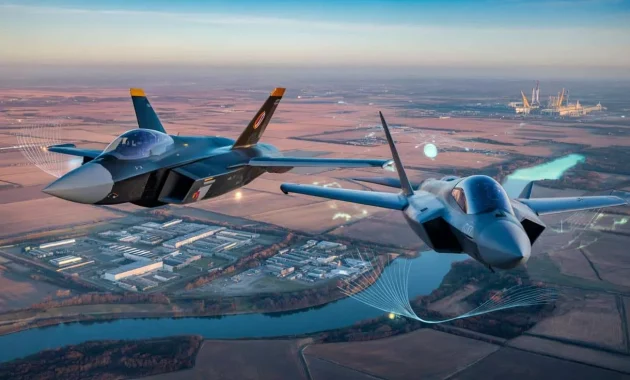
The Future Combat Air System (FCAS), a flagship European fighter jet project, has been mired in political and industrial squabbles for years. But a surprising new proposal from German unions could offer a way to break the deadlock. Their “two-aircraft” solution is shaking up the debate, hinting at a path forward that preserves national pride while meeting military needs.
The FCAS program has faced numerous challenges, from budget constraints to conflicting industrial interests. But the German unions’ proposal offers a novel approach that could chart a new course for the project. By embracing a two-aircraft solution, they aim to balance the demands of national sovereignty with the realities of modern defense capabilities.
This unexpected twist in the FCAS saga could have far-reaching implications, not only for the future of European defense cooperation but also for the broader landscape of military procurement and industrial collaboration. As the debate unfolds, stakeholders will need to carefully navigate the nuances of this proposal, weighing its potential benefits and risks.

The German Unions’ Two-Aircraft Proposal
The German metalworkers’ union IG Metall and the German Aerospace Industries Association (BDLI) have put forth a proposal that challenges the traditional FCAS framework. Instead of a single, next-generation fighter aircraft, they are advocating for a “two-aircraft” solution – a move that could reshape the entire program.
The unions argue that this approach would better serve the interests of the German defense industry, ensuring that both national champions, Airbus and Dassault, have a significant role to play. By splitting the FCAS into two distinct aircraft, the proposal aims to address the long-standing tensions between the industrial partners and preserve a degree of national autonomy.
Proponents of the two-aircraft plan believe it could strike a balance between political and military considerations, allowing for the development of a capable combat system while also satisfying the need for national self-reliance. However, the proposal has not been without its critics, who raise concerns about the potential for increased costs and technical challenges.

What “Two NGF Aircraft” Would Actually Mean
The German unions’ proposal envisions the FCAS program evolving into a “two-aircraft” solution, with each of the main industrial partners – Airbus and Dassault – developing their own next-generation fighter (NGF) aircraft. This would mark a significant departure from the original plan, which called for a single, collaborative platform.
Under the proposed model, Airbus would be responsible for one NGF aircraft, while Dassault would lead the development of the other. The two platforms would then be integrated into a broader “combat cloud” system, allowing for enhanced interoperability and the pooling of capabilities.
Supporters of the two-aircraft approach argue that this would mitigate the risk of technological and industrial dominance by a single partner, fostering a more balanced and equitable collaboration. However, critics warn that such a solution could lead to increased costs, potential duplication of efforts, and the challenge of maintaining common standards across the two platforms.

Lessons from the Engine Deal: The “Best Athlete” Principle
The ongoing debate around the FCAS engine deal offers valuable insights into the potential benefits of the two-aircraft proposal. In that case, the “best athlete” principle prevailed, with Safran and MTU Aero Engines being selected to jointly develop the engine, rather than a single national champion.
This approach, which prioritizes technical excellence over national interests, could serve as a model for the broader FCAS program. By adopting a similar philosophy, the two-aircraft solution could leverage the respective strengths of Airbus and Dassault, ensuring that the most capable platforms are developed.
However, the implementation of this principle will require careful coordination and a shared commitment to the overall success of the FCAS program. Stakeholders will need to navigate the delicate balance between national priorities and the pursuit of military superiority.

The Risks of Duplication and Drifting Standards
While the two-aircraft proposal offers potential benefits, it also raises concerns about the risks of duplication and the challenge of maintaining common standards across the platforms. Developing and integrating two separate NGF aircraft could lead to increased costs and complexity, potentially undermining the overall efficiency of the FCAS program.
Furthermore, the need to ensure interoperability and common capabilities across the two aircraft could become a significant hurdle. Diverging design choices, technological solutions, and operational requirements could create challenges in achieving the desired level of integration and seamless cooperation.
Stakeholders will need to carefully address these concerns, potentially through the implementation of robust governance structures, shared technical standards, and a strong commitment to collaboration. Failure to do so could result in the FCAS program drifting further away from its original objectives.

French Timelines and the Fear of a Capability Gap
The two-aircraft proposal also raises questions about the potential impact on the French defense industry and the broader European defense landscape. France has expressed a strong preference for a single, next-generation fighter aircraft, driven by concerns about maintaining its technological edge and avoiding a capability gap.
The French government and Dassault, the national champion, have been vocal advocates for a unified FCAS program, fearing that a two-aircraft solution could undermine their strategic positioning and lead to a fragmentation of European defense capabilities.
Reconciling these differing perspectives and timelines will be crucial to ensuring the success of the FCAS program. Failure to find a mutually acceptable compromise could jeopardize the project’s progress and have far-reaching consequences for European defense cooperation.

What “Combat Cloud” and “Program of Programs” Really Mean
Underlying the debate around the FCAS program is the concept of a “combat cloud” – a networked system that would integrate various platforms and capabilities, including the next-generation fighter aircraft. This “program of programs” approach aims to create a more resilient and adaptable defense system, leveraging the synergies between different components.
The two-aircraft proposal could be seen as a way to enhance this “combat cloud” concept, with the two NGF platforms serving as complementary nodes within a larger, interconnected ecosystem. By preserving a degree of national autonomy while enabling cross-platform integration, this approach could unlock new possibilities for European defense cooperation.
However, the successful implementation of the “combat cloud” vision will require overcoming significant technical and organizational challenges. Ensuring seamless interoperability, data-sharing, and command-and-control across multiple platforms and national systems will be a formidable task.

Possible Scenarios for a Two-Fighter Europe
As the FCAS debate continues, several potential scenarios emerge for the future of European defense aviation. The two-aircraft proposal could pave the way for a “two-fighter Europe,” where both Airbus and Dassault develop and field their own next-generation fighters, potentially with varying levels of interoperability and integration.
Alternatively, the two-aircraft solution could serve as a transitional phase, leading to a more unified FCAS program in the long run. In this scenario, the initial split could be followed by a gradual convergence or even a merger of the two platforms, creating a single, collaborative next-generation fighter.
Regardless of the specific outcome, the FCAS program’s evolution will have significant implications for the European defense industry, military capabilities, and the continent’s strategic positioning on the global stage. Stakeholders will need to navigate these complex dynamics with a clear vision and a commitment to finding a sustainable solution.

Broader Implications for European Defense Projects
The FCAS debate extends beyond the confines of the fighter jet program itself. The lessons learned and the decisions made in this process could have far-reaching implications for the future of European defense cooperation and the management of large-scale, multi-national defense projects.
The two-aircraft proposal, if adopted, could serve as a model for how to balance national interests and industrial priorities within the context of European defense initiatives. This could have implications for other programs, such as the Main Ground Combat System (MGCS) or the Maritime Airborne Warfare System (MAWS), where similar challenges of national sovereignty and industrial collaboration may arise.
Moreover, the FCAS case highlights the need for a more comprehensive and strategic approach to European defense planning, one that reconciles the diverse interests of member states and industry players. The successful navigation of this complex landscape could pave the way for more effective and coordinated defense capabilities across the continent.
| Key Aspects of the FCAS Two-Aircraft Proposal | Description |
|---|---|
| Airbus and Dassault as Lead Developers | The proposal envisions Airbus and Dassault each developing their own next-generation fighter aircraft as part of the FCAS program. |
| Preserving National Interests | The two-aircraft solution aims to address the long-standing tensions between the industrial partners and maintain a degree of national autonomy for Germany and France. |
| Integrated “Combat Cloud” System | The two NGF aircraft would be integrated into a broader “combat cloud” system, enabling enhanced interoperability and the pooling of capabilities. |
| Potential Challenges | Concerns about increased costs, technical challenges, and the difficulty of maintaining common standards across the two platforms. |
| Expert Opinions on the FCAS Two-Aircraft Proposal | Perspective |
|---|---|
|
Defense analyst, European think tank |
|
Aerospace industry expert, consultancy firm |
|
Security policy researcher, university |
The FCAS program’s journey has been anything but smooth, but the German unions’ two-aircraft proposal could signal a turning point. By balancing national interests and military needs, this novel approach offers a potential path forward for Europe’s flagship fighter jet project. As stakeholders navigate the complexities ahead, the lessons learned could shape the future of defense cooperation and industrial collaboration across the continent.
What is the FCAS program?
The FCAS (Future Combat Air System) is a multinational program led by Germany, France, and Spain to develop a next-generation fighter jet and associated technologies. It is a flagship project for European defense cooperation.
Why is the two-aircraft proposal significant?
The two-aircraft proposal, put forth by German unions, challenges the original FCAS plan for a single, collaborative fighter jet. It aims to preserve national industrial interests and autonomy while still delivering a capable combat system.
What are the potential benefits of the two-aircraft solution?
The two-aircraft approach could mitigate the risk of technological and industrial dominance by a single partner, fostering a more balanced and equitable collaboration. It may also enable the leveraging of the respective strengths of Airbus and Dassault.
What are the main concerns about the two-aircraft proposal?
Key concerns include the risk of increased costs, potential duplication of efforts, and the challenge of maintaining common standards across the two platforms. Ensuring seamless integration and interoperability within a “combat cloud” system could also be a significant hurdle.
How might the two-aircraft solution impact the European defense landscape?
The FCAS debate and the two-aircraft proposal could have broader implications for European defense cooperation and the management of large-scale, multi-national defense projects. It could serve as a model for balancing national interests and industrial priorities in future programs.
What are the potential scenarios for the future of the FCAS program?
The two-aircraft proposal could lead to a “two-fighter Europe,” with Airbus and Dassault each developing their own next-generation fighters. Alternatively, it could be a transitional phase towards a more unified FCAS program in the long run.
How will the FCAS decision impact France’s defense industry?
France has expressed concerns about the two-aircraft proposal, fearing it could undermine its technological edge and lead to a fragmentation of European defense capabilities. Reconciling French interests with the German-led proposal will be a key challenge.
What is the “combat cloud” concept in the context of FCAS?
The “combat cloud” refers to the networked system that would integrate the various platforms and capabilities, including the next-generation fighter aircraft, within the FCAS program. This “program of programs” approach aims to create a more resilient and adaptable defense system.