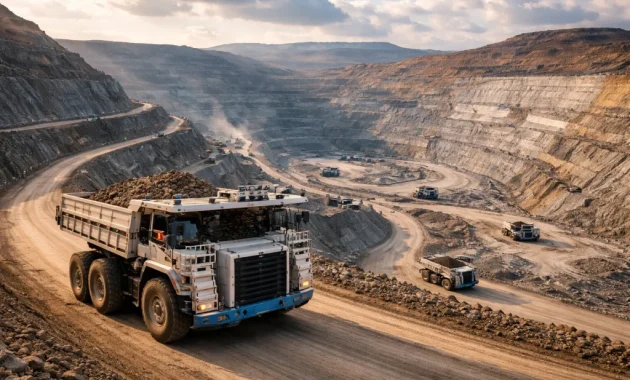
High in the Kunlun mountains, where temperatures plunge well below freezing and oxygen levels crash, China is testing whether machines can do what humans simply cannot: run a vast mine worth tens of billions of euros without ever stepping into the cab of a truck.
A mine too hostile for human workers
The Huoshaoyun mine sits at around 5,600 metres above sea level in the disputed Aksai Chin region of Xinjiang. That is higher than La Rinconada in Peru, often described as the world’s highest permanent settlement, where miners live with chronic altitude sickness and brutal working conditions.
At Huoshaoyun, just walking a few metres can leave a person gasping. Temperatures regularly hit -20°C, and the ground remains frozen for most of the year. Building and maintaining infrastructure in such conditions is difficult, keeping a large on-site workforce healthy and productive is even harder.
Yet beneath that hostile terrain lies a staggering prize: more than 21 million tonnes of lead and zinc, with an estimated value of around €45 billion. The deposit, identified in 2016, has been described as one of the largest lead-zinc resources on the planet and ranks among the top ten by size.
At 5,600 metres, Huoshaoyun promises tens of billions in metals, but the air is so thin that traditional mining becomes almost impossible.
Chinese company Guanghui Energy began developing the site in 2017. Subsequent surveys in 2019 suggested that the surrounding mountains also hold sizeable deposits, opening the door to a long-term mining complex rivaling some of the world’s largest operations.
Autonomous trucks take over the haul roads
How the driverless fleet actually works
To move ore in an environment where humans struggle to function, China has rolled out a fleet of driverless mining trucks, billed as one of the largest such deployments in the world. These are not standard vehicles with a few added sensors. They are purpose-built, autonomous platforms designed to handle steep grades, slippery ice and unpredictable rockfalls.
Each truck carries an array of cameras, lidar, radar and GPS equipment. Onboard computing systems fuse this sensor data to build a detailed, constantly updated picture of the surroundings. The vehicles identify obstacles, calculate safe paths and adapt speed and braking in real time.
The trucks communicate via 5G, share their positions and routes, and coordinate so tightly that traffic jams and collisions are largely engineered out of the system.
➡️ A new kitchen device is poised to replace the microwave for good, and experts say it’s far more efficient after extensive testing
➡️ Complete guide: How to use and install the Sengager.fr app
➡️ A retiree who lent his land to a beekeeper is told to pay farm taxes “I earn nothing from this,” he says, as the ruling sparks a heated national debate
➡️ According to psychology, underlining your name in a signature can reveal unexpected aspects of your personality
➡️ Japan crosses a strategic red line with a new stealth missile capable of mid-air corkscrew maneuvers to evade defenses and strike targets beyond 1,000 km
➡️ It’s not Chinese but Indian: a new maker of passenger jets arrives
➡️ Day set to turn into night as experts confirm exceptional eclipse duration raising excitement among astronomers
➡️ For the first time in 40 years, Panama’s deep waters failed to rise to the surface
The site is blanketed in a high-bandwidth 5G network powered by Chinese telecoms technology. This allows trucks to stream video back to control centres and receive updated instructions in milliseconds. If something looks off, remote operators hundreds of kilometres away can jump into a “virtual cab”, accessing a 360-degree view and taking manual control through screens and joysticks.
Human know-how is still there, but the body stays at low altitude, in heated offices with normal oxygen levels. It is a different kind of mining job: more like operating a flight simulator than sitting behind a wheel on a frozen mountain road.
Why machines beat people at 5,600 metres
At that altitude, human performance drops sharply. Reaction times slow, concentration fades and fatigue accumulates. For heavy trucks hauling ore on narrow benches, those factors make accidents far more likely.
- Drivers need long acclimatisation periods to avoid acute mountain sickness.
- Shifts must be shorter, with more breaks and medical monitoring.
- Winter conditions add further risk of frostbite, hypothermia and road icing.
Autonomous vehicles do not suffer those limitations. They can work continuously, unaffected by thin air or sub-zero temperatures, pausing only for refuelling, maintenance or software updates. Early tests at Huoshaoyun reportedly show higher consistency in haul cycles and fewer unplanned stoppages than with human drivers.
This consistency matters in mining economics. Regular, predictable truck movements keep crushers, conveyors and processing plants running close to capacity, improving the payback on the massive upfront investment in the mine.
From ore body to fully autonomous chain
Towards a stop-free production loop
For now, trucks haul ore from loading points to dumping or processing areas, then return along planned routes. The long-term aim is far more ambitious: a largely autonomous chain covering the entire journey from rock face to processing plant.
Engineers are already working on integrating autonomous excavators and drilling rigs. In that scenario, machines would blast rock, load it into driverless trucks, transport it to crushers and stockpiles, and feed automated processing lines. Human staff would supervise and adjust operations from afar, intervening mainly when something unexpected occurs.
| Stage | Current status | Automation goal |
|---|---|---|
| Drilling & blasting | Mixed, with human crews | Remote-controlled or fully autonomous drill rigs |
| Loading | Operators in excavators | Excavators guided by sensors and AI |
| Haulage | Autonomous trucks with remote oversight | 24/7 driverless operation with dynamic routing |
| Processing | Heavy automation already standard | Tighter integration with mine planning software |
If China proves that such a loop works reliably at Huoshaoyun, the model could spread to other difficult operations: high-altitude copper deposits, Arctic iron ore projects or even deep-mined rare earths.
Geopolitics, metals and a strategic message
Lead and zinc rarely grab headlines compared with lithium or nickel, yet they underpin modern industry. Lead remains central for industrial batteries, backup power systems and some types of radiation shielding. Zinc is crucial for galvanising steel, protecting everything from bridges to cars from rust.
By unlocking one of the world’s largest lead-zinc deposits, China strengthens its position in global metals supply at a time when many Western economies are trying to secure materials for infrastructure, energy storage and defence.
Running a €45 billion mine with robots is as much a statement of capability as a business decision.
There is also a signalling effect. China is showing it can safely operate complex, heavy equipment in zones where harsh weather, thin air or geopolitical sensitivities would make a large human footprint controversial or simply unworkable.
That expertise sits alongside wider moves into polar shipping routes, Arctic research stations and deep-sea mining tests. The message: if there is value in a place that makes humans uncomfortable or unwelcome, Chinese technology intends to work there anyway.
What this means for workers and safety
For the miners who might otherwise have been sent to Huoshaoyun, the shift to autonomy looks like a relief. Altitude sickness, frostbite and vehicle accidents on icy tracks are not romantic hardships; they are recurring causes of injury and death in high-mountain operations.
Removing drivers from cabs eliminates many direct risks. Yet new ones appear. Cybersecurity becomes critical: a hacked truck fleet on narrow benches would be a nightmare scenario. Software glitches, sensor failures or extreme weather that blinds cameras could also trigger dangerous incidents.
Regulators and companies will need robust testing, detailed incident reporting and independent reviews of safety algorithms. In practice, that means more specialised jobs in remote operations centres, maintenance hubs and data analysis units, and fewer traditional on-site driving roles.
Terms and tech worth unpacking
Why 5G matters in a mine
Mining has long used radios and basic wireless systems, but 5G offers far higher capacity and lower latency. That reduces the lag between a sensor detecting a rock on the road and a remote operator seeing it on screen. It also allows multiple HD camera feeds, lidar data and control signals to run simultaneously.
For autonomous haulage, this responsiveness can be the difference between a smooth emergency stop and a costly collision. It also means fleets can be updated with new maps, software patches and AI models without taking vehicles out of service for long.
What “autonomous” actually covers
The industry typically uses levels of autonomy similar to the car sector. At Huoshaoyun, trucks appear to operate at something close to “high automation”: they drive themselves under most conditions along predefined haul roads but still rely on human intervention for rare or complex situations.
Scenarios likely to trigger human takeover include:
- sudden rockfalls blocking haul roads
- unexpected wildlife or people straying into the pit area
- extreme weather that overwhelms sensors, such as white-out snowstorms
- major equipment faults detected by onboard diagnostics
Each such event feeds data back into the system, helping developers refine algorithms and reduce the need for interventions over time. In that sense, Huoshaoyun is both a mine and a large outdoor lab for Chinese autonomy tech.
From Kunlun peaks to future frontiers
The approach being tested at Huoshaoyun points toward a future where remote, machine-run sites become the norm for the harshest environments. Once you can coordinate heavy robots at 5,600 metres, the same principles apply to Antarctic research bases, offshore wind farms in storm-prone seas or eventually, resource extraction on the Moon or Mars.
That raises new questions for governments and companies. Who is liable when an AI-controlled truck causes an accident? How should labour laws adapt when a “mine worker” is a person in a control room thousands of kilometres away? And what happens to mining communities when jobs move from mountain towns to urban tech hubs?
For now, Huoshaoyun offers a glimpse of those debates in concrete form: steel, circuits and sensors grinding across frozen rock to unlock €45 billion worth of metals, while the people running the show watch from a safe distance, breathing easy air.