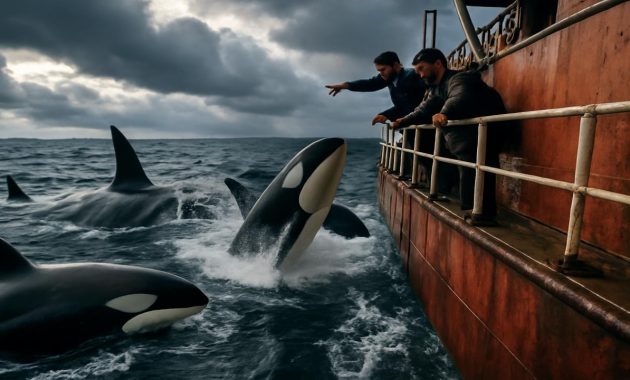

The captain did not see the orca until her white eye patch flashed beneath the steel hull. By then, the wheel was already jerking in his hands, the rudder shuddering as if the ocean itself had grown teeth. Somewhere below, in the cold, dark water off the Iberian Peninsula, a pod of orcas moved with eerie coordination—circling, diving, then ramming the vessel’s underside with a force that felt, he would later say, “like a slow, methodical anger.” The sea, usually a place of indifferent power, suddenly seemed to be paying very specific attention.
A New Kind of Encounter at Sea
For centuries, sailors have spun stories of strange happenings in the North Atlantic—rogue waves, ghost ships, whales the size of islands. Yet what’s unfolding now along the coasts of Portugal, Spain, and increasingly farther north, feels different. It’s not myth and not misidentification. It’s documented, filmed, plotted on charts and reported in formal incident logs: orcas are targeting commercial vessels in what many experts are now cautiously calling coordinated assaults.
It began as a trickle of reports a few years ago. A sailboat off Gibraltar had its rudder battered by a group of orcas. Another boat near the Strait of Gibraltar lost steering completely when its rudder was snapped like a twig. At first, the maritime world shrugged—rare, unfortunate, but perhaps an anomaly. Then the maps began to fill in. Red pins for rudder damage. Blue pins for full-on vessel incapacitations. The spread was unsettling: Portugal, Spain, France, then farther west toward the Azores and north along shipping routes where cargo and fishing vessels make their living.
On radio channels once reserved for routine weather updates and traffic advisories, new kinds of calls came through. Calm but edged with disbelief:
“We’re under interaction with orcas… yes, multiple animals… they’re coming back to the rudder.”
“We’ve lost steering. Orcas still present. Requesting assistance.”
You can almost hear the pause as the operators on the other end absorb the words. Not pirates. Not technical failure. Killer whales.
The Strange Strategy of the Rudder Attack
To watch a video of these interactions is to feel your understanding of “wild animal behavior” quietly rearrange itself. The water is calm. A sailboat’s wake ribbons softly behind its stern. Then, like monochrome thunderbolts, the orcas appear. One, then two, then three—sleek black backs slicing the surface, dorsal fins in perfect arcs. They do not appear frantic. They are not feeding. They move with a kind of practiced intention.
Almost every account describes the same pattern: the orcas head straight for the stern and focus on the rudder. They push it. They bite it. They sometimes roll onto their backs beneath the hull, bracing themselves to slam upward into the vulnerable structure that controls the vessel’s direction. In many cases, they ignore everything else—the hull, the crew, the propeller. The rudder is the target, as if they’ve circled it in red ink on some internal diagram of how boats move.
More fascinating—and more unsettling—is what happens next. Sometimes, after destroying the rudder or rendering it useless, the orcas simply… stop. They drift away, surfacing at a distance as if admiring their work. There’s no reliable sign of feeding on the broken pieces. No attempt to harm the humans onboard. The interaction appears to be about control, about neutralizing the vessel’s movement.
From the human perspective, the emotional tide that follows is intense. Fear, certainly—being in a disabled boat, in open water, with large predators circling just below the surface, is a primal nightmare. But there is also a startled wonder. “They knew exactly where to hit us,” one mariner said afterward. “They understood the boat better than some new crew members do.”
Are Orcas Really Coordinating These Assaults?
To call these behaviors “coordinated assaults” is not mere sensationalism. Marine biologists, often reluctant to anthropomorphize wild animals, are still careful with their language—but the pattern is hard to ignore. These are social animals, used to hunting in organized pods, capable of complex collaboration that rivals that of wolves or chimpanzees. They communicate using distinct dialects of calls and clicks. They pass on learned behaviors across generations.
In the case of the North Atlantic interactions, many researchers suspect a social transmission: a behavior that began with one curious or traumatized individual and then spread through her social group. One orca in particular—often dubbed the “ringleader” in headlines—has been observed frequently near such incidents. Some scientists speculate that she might have had a negative interaction with a boat in the past: a collision, an injury, the loss of a calf. We don’t know. What we do know is that orcas remember. Their emotional and cognitive lives are not simple.
Once a new behavior appears in a pod, especially one as stimulating as disabling a moving object the size of a house, it can become contagious. Is it play? Is it revenge? Is it experimentation? The answer might be all three, or something we don’t yet have words for.
When Technology Meets Teeth: The Human Toll and Response
From a distance, from the safety of a living room or a phone screen, it’s easy to watch a video of a rudder-breaking orca and feel only awe. But for those whose lives depend on the sea, the story carries a different weight.
Fishermen in small commercial boats face tight margins and brutal schedules; a disabled vessel means lost catch, costly repairs, and sometimes perilous hours of drifting before help arrives. Cargo ships, with their deeper drafts and heavier hulls, have fewer documented issues so far—but commercial sailing vessels, whale-watching boats, and smaller workboats are increasingly wary. Insurance claims are rising. Some harbors now post advisories, like weather alerts, about orca activity zones.
In the harbors of Galicia or the marinas of southern Portugal, the conversations on the docks have changed. Alongside the usual talk of fuel prices and changing regulations, there’s a new question merchants and crews ask: “Have you had the orcas yet?”
Mitigation strategies—some ingenious, some desperate—are being tested in real time:
- Slowing or stopping vessels when orcas are sighted, hoping to reduce their interest in a non-moving target.
- Deploying noise deterrents, from banging on the hull to specially designed acoustic devices.
- Altering routes, hugging the coast or detouring around known hotspots, at the expense of time and fuel.
- Reinforcing rudders with stronger metals or protective cages, a sort of armor against repeated impacts.
But the central tension is this: these animals are protected. Many populations of orcas around the world are endangered or vulnerable. Lethal measures are off the table, both ethically and legally. The response must be as intelligent—and as patient—as the animals themselves.
| Aspect | Details Observed in Orca–Vessel Interactions |
|---|---|
| Main Target | Rudders of sailboats and smaller commercial vessels; limited damage to hulls. |
| Typical Location | Coastal waters of the Iberian Peninsula, expanding into broader North Atlantic routes. |
| Group Behavior | Multiple orcas working together, often 2–6 animals focusing on the same area of the boat. |
| Primary Impact on Humans | Loss of steering, vessel immobilization, financial costs, and heightened fear among mariners. |
| Observed Outcomes | Few injuries to humans; significant mechanical damage; orcas usually depart after disabling the vessel. |
Intelligence Looking Back at Us
For many who work on or study the sea, this moment with the orcas feels like a mirror being lifted. We have always known orcas are intelligent. We’ve watched them choreograph hunts, share food, teach their young. We’ve marveled at their ability to adapt—raiding fishing lines in Alaska, ambushing seals off ice floes in Antarctica, driving herring into tight, silver balls in Norwegian fjords.
But there is something profoundly disquieting about realizing that these animals are now experimenting with our technology. The boat, that quintessential human tool for crossing and exploiting the ocean, has become their plaything, or their punching bag, depending on how you see it. The creatures we have long chased, captured, displayed, and—too often—driven away from their feeding grounds, are now pushing back in a way that feels deliberate.
Standing on a heaving deck, clutching a suddenly useless wheel, a captain can no longer pretend that he is the only strategist in the room. Under the waterline is another mind, another culture, operating on a different frequency but trained, just as his is, in the art of reading conditions and making bold moves.
A Planet of Colliding Needs
If you zoom out from the single boat and single pod, the story of the North Atlantic orcas folds into a larger narrative—one of pressure, noise, scarcity, and change. The ocean is louder than it has ever been. Shipping routes are highways of mechanical rumble. Sonar pings. Underwater construction hammers away at continental shelves. Fishing fleets sweep through the same traditional hunting grounds that orcas once had to themselves.
Layer onto that the shifting of climate: prey species moving north or deeper, water temperatures rising, patterns of migration blurring. Orcas, like many top predators, are simultaneously adaptable and vulnerable. They can learn new tactics, but they cannot negotiate treaties, cannot ask a regulatory body to reduce shipping traffic, cannot write a memo about depleted fish stocks. What they can do is experiment, and sometimes that experiment looks like: “What happens if we stop this thing that moves?”
Humans often like to think of the ocean as a stage we use, a backdrop to commerce and exploration. But the orcas, in their black-and-white certainty, remind us of a less comforting truth: the stage is inhabited. It has its own rules, its own architects of pressure. In some distant way, these interactions may be the marine equivalent of a city-dwelling fox rifling through trash cans, or elephants raiding crops—only here, the scale is bigger, the technology more advanced, and the emotional punch much stronger.
Between Wonder and Warning
There is a thin, vibrating line between being awed by these animals and being warned by them. On one side lies the fascination: that a mammal with a brain weighing up to 15 pounds is not just surviving but actively investigating the machines that dominate its world. On the other side lies discomfort: that our dominance is not as unquestioned as we believed, that even our best-built vessels have weak points discoverable by a curious pod.
Scientists urge caution against over-romanticizing these encounters as some kind of righteous revenge. Nature is not a morality play, at least not in the simple sense we often crave. But it is fair to say that these orcas are communicating something, even if they don’t mean to. They are telling us, with every shattered rudder, that we are deeply entangled with their world—and that our presence has consequences that spiral out in ways we are only beginning to see.
It may be, years from now, that this period will be looked back on as a fleeting cultural fad among a specific orca population, a strange footnote in marine biology textbooks. Or it may be remembered as a turn in the relationship between industrial seafaring and the ocean’s apex minds—a moment when we were forced to remember that the ocean does not belong solely to us.
Listening for the Future
For now, captains on the North Atlantic trade routes chart their courses with a new kind of awareness. A red circle marked “recent orca interaction” may alter a schedule or a delivery date. Insurance forms gain a new category: damage by marine mammal. Training sessions for crew now include, in some regions, a surreal briefing on what to do if a pod decides to take an interest in your rudder.
In quiet coastal labs and on pitching research vessels, scientists are recording every incident, logging every GPS coordinate, reviewing every second of video footage. They hold hydrophones in the water, listening for patterns in orca calls before, during, and after interactions. They cluster around spectrograms as if deciphering a code—which, in a very real sense, they are.
And perhaps, if we are wise, we will let this moment change us just a little. Not in panic, and not in defiance, but in humility. To share the sea with a creature capable of coordinated assaults on our most advanced tools is to admit that we are not alone in writing the story of this planet.
Imagine, for a moment, the view from below. The shadow of the boat passes overhead, a dark, straight line on the bright ceiling of the surface. The keel hums; the propeller whispers; the rudder swings, directing ton after ton of steel and cargo and human intention. Then, out of the blue, a family of black-and-white hunters arrives and, through a combination of strength, memory, and curiosity, stops the machine in its tracks. The boat is not the only agent here. The water is not just water. It is a living, thinking, reacting space.
Somewhere out there tonight, under a cloudy North Atlantic sky, a commercial vessel pushes through a long swell. The crew scans the horizon for storms, for other ships, for floating debris. What they cannot see, just yet, is the flicker of white patches deep below, the quiet of enormous lungs filling, the gathering of a pod that may or may not decide to turn its attention toward the moving thing overhead.
The warning, if we choose to hear it, is not only that orcas are targeting our vessels. It’s that the ocean is more alive, more observant, and more entangled with our fate than we’ve allowed ourselves to remember. The question is not just how we will defend our rudders, but how we will navigate a world where intelligence looks back at us from the water and, for the first time in a long while, makes us wonder who is studying whom.
FAQ
Are orcas really attacking ships, or is this exaggerated?
The incidents are real and well documented. Multiple vessels, including commercial and recreational boats, have reported orca interactions that result in damaged or destroyed rudders. While media coverage can be dramatic, the core behavior itself is not exaggerated.
Are these attacks dangerous for humans on board?
So far, injuries to humans have been extremely rare. The orcas focus on the boats’ rudders rather than on people. The main danger comes from losing steering or becoming stranded at sea, rather than from direct aggression toward humans.
Why are orcas targeting rudders specifically?
The exact reason is unknown, but several hypotheses exist. Rudders move, create pressure waves, and represent a clear control point for a vessel. Orcas may find them stimulating to manipulate, may associate them with previous negative experiences, or may have developed this behavior as a form of play or experimentation.
Is this behavior spreading to other orca populations?
Right now, the rudder-focused interactions are mainly associated with specific pods in the North Atlantic, particularly around the Iberian Peninsula. There is no solid evidence yet that this behavior is common in other global orca populations, though researchers are watching closely.
What can vessels do to avoid or minimize these interactions?
Current recommendations often include slowing down or stopping when orcas appear, avoiding sudden maneuvers, staying in contact with local maritime authorities, and checking updated charts for known orca activity zones. Some vessels are experimenting with reinforced rudders or noise deterrents, but no method is guaranteed.
Are orcas considered dangerous predators to humans generally?
In the wild, confirmed cases of orcas killing humans are extremely rare. Despite their size and hunting power, most wild orca–human encounters are neutral or even curious rather than aggressive. The orcas’ interactions with vessels appear focused on the hardware, not the people.
Could this lead to conflicts or culls of orcas?
Because many orca populations are protected and some are threatened, lethal responses would face legal, scientific, and public opposition. The current focus is on research, non-lethal deterrents, and operational changes at sea. How societies choose to respond long term will depend on both the frequency of interactions and our willingness to adapt.
