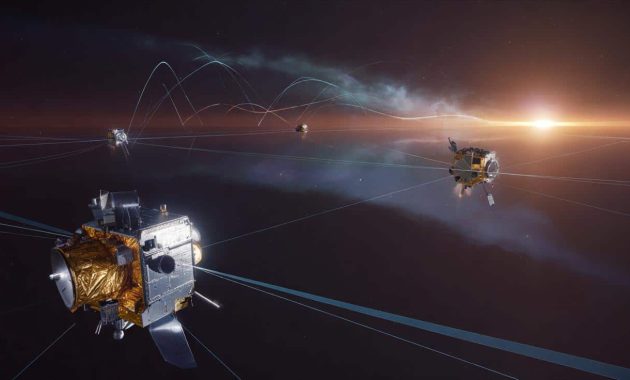
Engineers across Europe are stitching together one of the most delicate space missions ever attempted, a three‑probe observatory designed to pick up ripples in spacetime that Albert Einstein predicted 110 years ago, but that Earth‑based detectors can only sense in part.
Einstein’s century‑old prediction heads for deep space
Gravitational waves are tiny ripples in spacetime, produced when massive objects like black holes or neutron stars accelerate and collide. Einstein’s general relativity, published in 1915–1916, implied they should exist, but he doubted anyone would ever measure them.
Ground‑based observatories such as LIGO and Virgo eventually did. In 2015, they recorded the merger of two black holes more than a billion light‑years away. That detection opened gravitational‑wave astronomy, but with strict limits.
Telescopes on Earth sit on a restless planet. Seismic vibrations, human activity and the pull of local gravity swamp the slow, long‑wavelength signals coming from some of the most intriguing events in the cosmos.
LISA aims to “hear” spacetime stretching and contracting at frequencies completely out of reach for observatories anchored to Earth.
This is where the European Space Agency’s Laser Interferometer Space Antenna, or LISA, comes in. Instead of building bigger facilities on the ground, scientists want to move the entire experiment into a quiet orbit around the Sun.
A triangle of satellites 2.5 million kilometres apart
LISA will consist of three identical spacecraft flying in an enormous triangle. Each side of this triangle will span 2.5 million kilometres, roughly seven times the distance from the Earth to the Moon.
The trio will trail (or in some scenarios slightly lead) Earth along its orbit, forming a giant laser ruler in space. Inside each satellite sit test masses: small blocks of metal that act as near‑perfect free‑falling objects, influenced only by gravity.
Ultra‑stable laser beams will bounce between the spacecraft and measure the distance between those test masses to picometre precision — thousandths of a billionth of a metre, smaller than many atoms.
➡️ One of the rarest sea creatures on the planet washes up on a US beach
➡️ I used to clean randomly until I followed this simple structure
➡️ At 5 years old, he sells hot chocolate and raises a crazy amount to give shelter dogs their freedom
➡️ Israel’s multi-front war, lasers and unmanned systems: 2025 review
➡️ A bay leaf under the pillow: The small night routine I once mocked – until it changed my sleep
➡️ Great injustice or legal necessity? A retiree who lent land to a beekeeper is forced to pay agricultural tax even though ‘I’m not making any money from this’ in a case that bitterly divides opinion
➡️ “I learned this pasta recipe the hard way, and now I never make it differently”
➡️ “I work as a maintenance planner, and this job pays for consistency, not pressure”
If a gravitational wave sweeps through, it will stretch one arm of the triangle and squeeze another, changing the laser path lengths by a distance comparable to a fraction of an atom over millions of kilometres.
Why space offers a new kind of listening
By moving into space, LISA accesses much longer gravitational wavelengths, corresponding to events unfolding over minutes to hours rather than fractions of a second.
That band of frequencies, roughly from 0.1 millihertz to 1 hertz, opens a fresh catalogue of cosmic sources:
- Slowly spiralling supermassive black hole pairs in the centres of galaxies
- Compact pairs of white dwarfs and neutron stars in our own Milky Way
- Potential signals from the first instants after the Big Bang, long before the first stars formed
Instead of brief, thunder‑like bursts, LISA will pick up long, evolving tones, sometimes tracking a system for years. That timeline lets researchers reconstruct masses, spins and even the shape of spacetime around black holes with high detail.
Thales Alenia Space and Europe’s delicate propulsion challenge
The European industrial machine behind LISA is now moving from studies to hardware. In January 2026, Thales Alenia Space, majority‑owned by French group Thales, signed a €16.5 million contract with German firm OHB System AG to supply the mission’s propulsion subsystem.
This first contract, covering design and early development (phase B2), will later expand across phases C and D, with a total value approaching €89.5 million. The work is led from the company’s UK teams, but involves several European sites.
Propulsion on LISA is not just a way to move from A to B. The thrusters must constantly counteract tiny disturbances that would push the spacecraft away from the test masses at their centres.
The ambition is almost paradoxical: the satellites must “disappear” around their payloads so that only pure gravity guides the test masses.
DFACS: making a spacecraft follow a falling object
At the core of that trick lies the Drag‑Free and Attitude Control System, or DFACS. Usually, a spacecraft drags its experiments along with it. LISA inverts that idea.
Sensors measure how the test masses try to drift inside each spacecraft. DFACS then commands micro‑thrusters to push or pull the entire satellite, keeping it centred around those freely falling blocks.
The system must also adjust the spacecraft orientation so that the laser beams stay perfectly aligned across millions of kilometres, while compensating for solar radiation pressure and residual forces from the spacecraft itself.
Italian aerospace group Leonardo, which owns a third of Thales Alenia Space, will provide some of the micro‑propulsion hardware. These thrusters are capable of delivering extremely small, precisely controlled impulses, like tapping a 2‑tonne bus with the force of a feather and doing so repeatedly for years.
A finely tuned European industrial network
LISA brings together expertise from several countries, in a kind of distributed factory for space science:
- Turin, Italy: teams build on concepts from early study phases and develop parts of the payload environment.
- Gorgonzola, near Milan: engineers integrate the on‑board computer and mass memory as a single unit.
- Swiss sites: specialists design electronics for the interferometer and systems that keep the three‑satellite constellation synchronised.
Thales Alenia Space is also responsible for avionics, control software, the communications system and careful management of electromagnetic, radiation and local gravity conditions inside each spacecraft.
This industrial chain must deliver hardware that can operate for at least six and a half years, with a possible extension of two and a half years, while maintaining measurement precision to the picometre scale.
France’s CNES builds LISA’s digital brain
On the science and data side, the French space agency CNES plays a central role. It leads the Distributed Data Processing Center, the digital “back office” that will transform raw laser interference patterns into gravitational‑wave signals and astrophysical catalogues.
A main computing centre in France will be linked to national centres in partner countries. Every day, these facilities will ingest streams of data from the three satellites, correct for instrumental effects and extract the faint signatures of distant cosmic events.
In Toulouse, French laboratories are already operating two prototype interferometers to test LISA‑like setups. One major challenge: stray light bouncing inside the optical system. Even tiny unwanted reflections can mimic the changes that gravitational waves would cause in the laser signals.
By rehearsing the full chain, from hardware to algorithms, European teams want to ensure that any signal attributed to a black hole merger or early‑universe echo stands up to scrutiny.
LISA’s family tree: from LISA Pathfinder to Gaia and Euclid
The mission does not start from scratch. In 2015, ESA launched LISA Pathfinder, a smaller spacecraft designed purely to test the drag‑free concept and precision metrology in space.
LISA Pathfinder successfully kept two test masses in almost perfect free fall, beating its performance targets by a large margin. That success gave engineers confidence that full‑scale LISA is technically achievable.
Other ESA observatories, such as Gaia (which maps the positions and motions of more than a billion stars) and Euclid (which studies dark matter and dark energy), have also contributed. Both rely on ultra‑stable pointing and fine attitude control over long periods, providing a heritage of sensors, algorithms and operating procedures.
This stack of missions reduces uncertainty, but LISA still pushes boundaries. No one has previously tried to keep a formation of three spacecraft so precisely arranged over millions of kilometres for nearly a decade while measuring distances at atomic scales.
Ariane 6 and the road to a 2035 launch
The current schedule targets a 2035 launch on an Ariane 6 rocket from Europe’s spaceport in Kourou, French Guiana. All three LISA spacecraft are expected to ride together, then slowly drift into their final triangular configuration around the Sun.
Once operations begin, astronomers anticipate a stream of data that reshapes several fields at once: black hole growth, galaxy evolution, dense stellar remnants and possibly physics beyond Einstein’s equations.
Key LISA facts at a glance
| Parameter | Value / description |
|---|---|
| Number of spacecraft | 3 identical satellites in a triangular formation |
| Arm length | 2.5 million km between satellites |
| Frequency band | ≈ 0.1 mHz to 1 Hz (long‑period gravitational waves) |
| Primary mission duration | 6.5 years, extendable to about 9 years |
| Launch vehicle | Ariane 6 (ESA) |
| Main industrial roles | Thales Alenia Space, OHB, Leonardo and several European partners |
Gravitational waves, simply put
For non‑specialists, terms like “spacetime metric perturbations” can feel opaque. A more intuitive way to think about gravitational waves is to picture a flexible rubber sheet standing in for spacetime.
Place heavy balls on that sheet and it bends. If you make the balls move quickly around each other, ripples spread across the surface. In reality, spacetime is four‑dimensional, not a flat sheet, but the basic idea carries through: changing gravitational fields send out waves that slightly stretch and compress distances.
On Earth, LIGO uses 4‑kilometre‑long arms to sense this stretching, corresponding to changes smaller than a proton’s width. LISA will scale up the arm length by a factor of hundreds of thousands, while chasing signals at much lower frequencies. Each approach targets a different “octave” of the cosmic soundtrack.
What LISA could reveal about our cosmic history
Researchers are already running simulations of the signals LISA might catch. In one scenario, the observatory tracks the slow dance of two supermassive black holes as their orbits tighten over years, eventually crashing together and shaking spacetime across the universe.
In another, it listens to hundreds of compact binary systems in the Milky Way. Many of those pairs may never emit enough higher‑frequency waves to be heard from the ground. LISA turns them into a new class of standard “sirens”, helping chart distances across the galaxy.
There is also a tantalising possibility: a faint, ever‑present hum from processes in the very early universe, such as phase transitions shortly after the Big Bang. Detecting that background would give physicists a direct test of phenomena at energies impossible to reach in human‑made accelerators.
Risks, challenges and what could go wrong
A project of this scale carries serious risks. The drag‑free control must run without interruption for years. A failure in the micro‑thrusters, or unexpected contamination affecting the test masses, could limit performance.
The data analysis challenge is also daunting. Signals from many sources will overlap, like hundreds of radio stations broadcasting on nearby frequencies. Teams must disentangle them without misidentifying artefacts from the instruments as exotic physics.
Yet the potential payoff is hard to ignore. By combining LISA’s low‑frequency signals with high‑frequency detections from ground‑based observatories, scientists aim to reconstruct events across a wide range of scales, from stellar‑mass collisions to galaxy‑scale mergers.
For the first time, humanity could map how black holes of all sizes formed, grew and reshaped their host galaxies across cosmic time.
LISA also trains a generation of engineers and scientists in ultra‑precise metrology, formation flying and advanced data processing. Those skills feed directly into future missions, from climate‑monitoring satellites that measure sea‑level changes by millimetres to deep‑space probes that rely on drag‑free techniques for navigation.